Chaos Vantage
Falloff
This page provides details about the Falloff texture in Chaos Vantage.
Last updated 28 February 2026
This page provides details about the Falloff texture in Chaos Vantage.
Overview
The Falloff texture produces a gradient texture based on the angular falloff of the surface of the geometry to which the texture is applied. The resulting map can simulate the falloff of opacity, reflection, and refraction for surfaces where these properties vary depending on the surface's angle to the camera, such as curved glass or water.
To create the texture, Falloff starts with two colors, usually black and white. Placement of these colors on the surface is based on the falloff type and falloff direction selected. The remainder of the map is generated as a gradient between these two colors, with a gradual falloff between the colors.
Main Settings
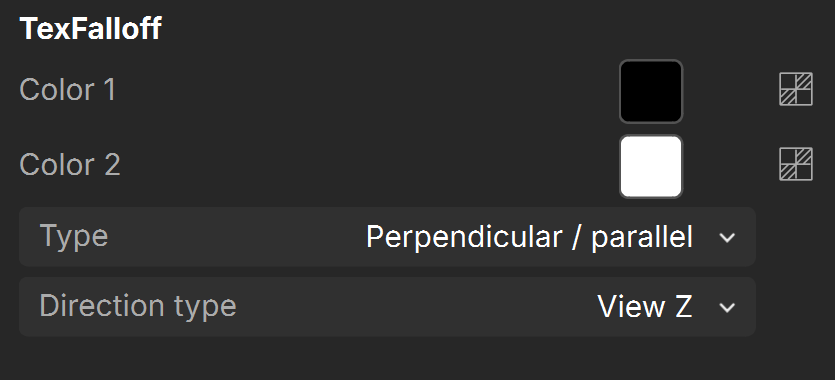
Color 1 / Color 2 – Sets the extreme ends of the range of colors for the Falloff Map's gradient. The specific placement of these colors on the surface is determined by Type and Direction type. See the Falloff Type example below.
Type – Specifies the type of falloff. See the Falloff Type example below.
Towards/away – Based on face normal directions. Faces with normals that point in the Direction type generate Color 1 while those facing in the opposite direction (180 degrees off the falloff direction) generate Color 2.
Perpendicular/parallel – Based on face normal directions. Faces with normals that point in the Direction type generate the Color 1 while those facing in a perpendicular direction (90 degrees off the falloff direction) generate the Color 2.
Fresnel – Based on changes to the index of refraction (IOR) over the surface due to Fresnel calculations. Faces with normals that point in the Direction type generate the Color 1 and those facing in other directions generate varying colors depending on the IOR set by Fresnel IOR.
Distance blend – Sets the falloff range based on distance from the camera, as specified by Distance Near and Distance Far. This option is useful for generating a Z-depth type of map when rendering a very large object such as terrain, where the Falloff Map can be used as a mask to dim distant details.
Direction type – Specifies the falloff direction to be used by the falloff type.
View Z/View X/View Y – Uses the camera viewing direction. This is the most common selection.
Explicit – Uses the direction specified by the Explicit Direction parameter.
Local X/ Local Y / Local Z – Uses one of the object's local axes.
World X / World Y/ World Z – Uses one of the world axes.
Ref node offset – Uses the direction specified by the Node ref offset parameter.
Fresnel IOR – Specifies IOR for the Fresnel falloff type.
Distance Near – Specifies near distance for the distance blend falloff type.
Distance Far – Specifies far distance for the distance blend falloff type.
Explicit Direction – Specifies the direction for falloff when Direction type is set to Explicit.
Node ref offset – Specifies the direction for falloff when Direction type is set to Ref node offset.
For information about the parameters in the Common and Mapping Properties tab, see the Textures page.
Examples
The following examples demonstrate the effect that individual Falloff Texture parameters have on the scene. Click on any image to view it at a higher resolution.
Example: Falloff Type
This example shows how Color 1 and 2 control the range of colors for the Falloff's gradient when the texture is mapped to the VRayMtl's Diffuse slot. Color 1 is the main color for the object, while Color 2 gives it a tint. The distribution of Color 1 and 2 can be controlled by the Falloff Type and Falloff Direction Type parameters.
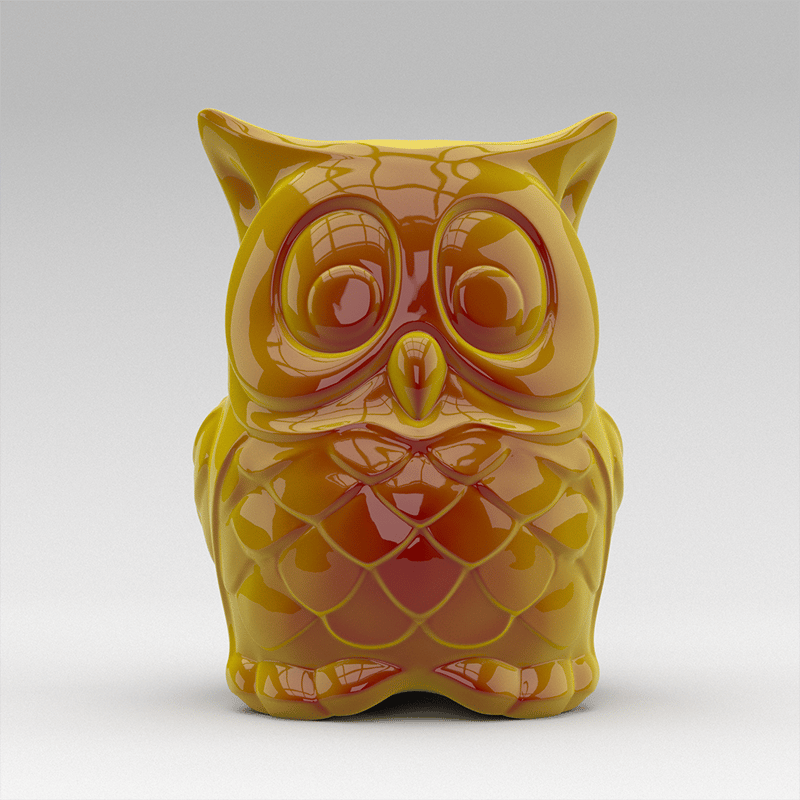
Here, we've set red as Color 1 and yellow as Color 2. The Falloff Direction Type is View Z. By changing the Falloff Type, we control the gradient spread.
Type = Towards/away
Type = Perpendicular/parallel
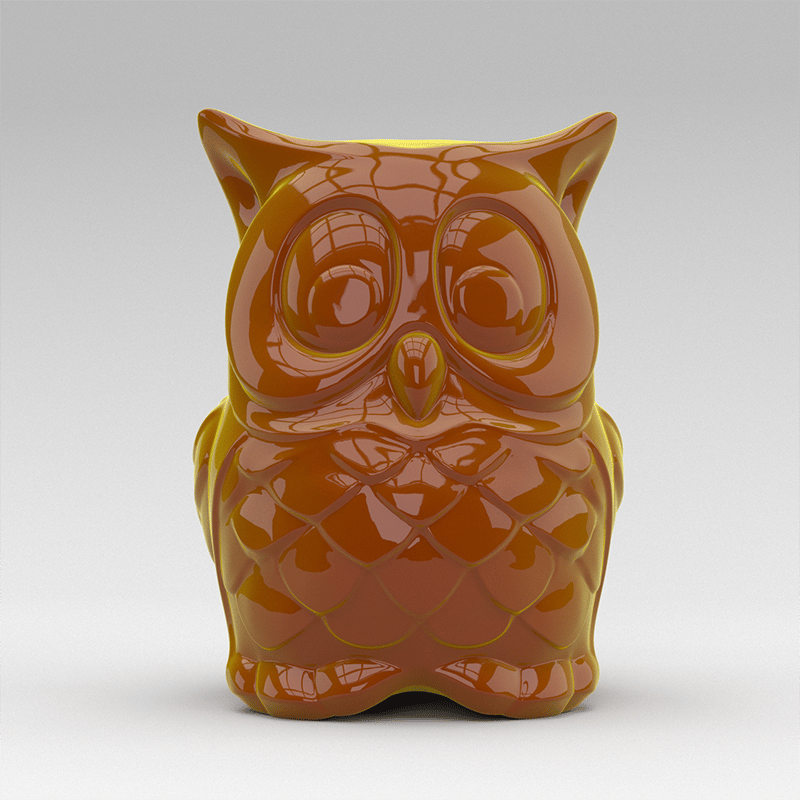
Type = Fresnel
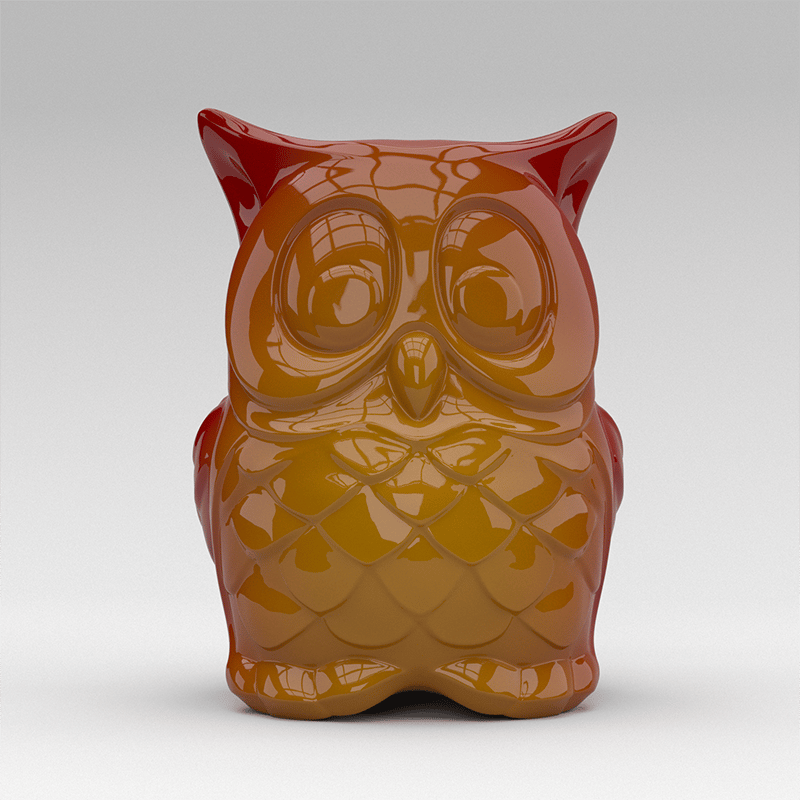
Type = Distribution blend (Distance Far = 5.8)