V-Ray for Blender
Granite
This page provides information about the Granite texture in V-Ray for Blender.
Last updated 11 December 2025
This page provides information about the Granite texture in V-Ray for Blender.
Overview
The Granite texture map generates a procedural Granite texture. It uses four colors that can be changed or assigned to texture maps.
UI Path: ||V-Ray Node Editor|| > Shader > Add > Textures > V-Ray Granite

Node Input Sockets
This section describes the input sockets of the node. Some sockets have dedicated parameters, which are further described below, and some sockets are just inputs.
Color 1,2,3, Filter – Allows color nodes to be assigned as the colors of the Granite texture.
Cell Size – Allows an integer-outputting node to be connected as the Cell Size parameter.
Density – Allows an integer-outputting node to be connected as the Density parameter.
Mix Ratio – Allows an integer-outputting node to be connected as the Mix Ratio parameter.
Spottiness – Allows an integer-outputting node to be connected as the Spottiness parameter.
Randomness – Allows an integer-outputting node to be connected as the Randomness parameter.
Threshold – Allows an integer-outputting node to be connected as the Threshold parameter.
Output
Color Mult – Allows a color node to determine the multiplier of the ramp colors.
Color Offset – Allows a color node to determine the offset of the ramp colors.
Alpha Mult – Allows a float node to determine the multiplier for the alpha value.
Alpha Offset – Allows a float node to determine the offset of the alpha value.
No UVs Color – Allows a color node to serve as the fallback color.

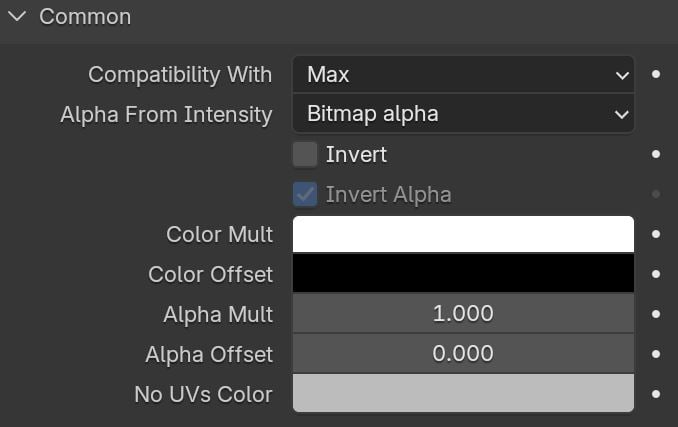
Common
Compatibility With – Allows you to match the result of the texture in Blender to that in either 3ds Max or Maya:
Max – The resulting alpha of the texture is the intensity of the texture.
Maya – The resulting alpha of the texture is the color luminescence.
Alpha From Intensity – Determines how the alpha of the result is calculated:
Bitmap alpha – The Alpha channel is drawn from the texture.
Color intensity/luminance – Alpha is generated from pixel intensity.
Force Opaque – Alpha channel is fully opaque.
Invert – When enabled, inverts the colors in the final result.
Invert Alpha – Inverts the alpha channel if Invert is also enabled.
Color Mult – Corrects the color of the texture by multiplying the color values in the texture with the color values specified here.
Color Offset – Corrects the texture's color by adding the RGB color values specified here to the color values of the texture.
Alpha Mult – A Multiplier for the Alpha value.
Alpha Offset – Determines the offset value for the Alpha.
No UVs Color – Specifies a default color used for polygons with no valid UVs. In case the map is not tiled, specifies a default color that is used outside the texture square.
Mapped
Wrap – When enabled, UVs outside of the object will wrap back to the valid range.
Placement Type – Select how to place the texture.
Full – Uses the full valid portion of the texture.
Crop – Allows the user to specify a section of the texture using the parameters below.
Place – Allows the user to specify a section of the texture and how to place it using the parameters below.
U – U coordinate of the texture sector.
V – V coordinate of the texture sector.
W – W coordinate of the texture sector.
H – Specifies the height of the texture sector.
Jitter – Specifies a randomization value for the UV placement.
Tile U/ Tile V – Enable to choose between horizontal or vertical tiling.
UV Noise On – Enables the noise.
Animate UV Noise – If enabled, the noise is animated. Use the UV noise phase to animate the noise.
UV Noise Amount – Specifies the UV noise amount.
UV Noise Levels – Specifies the UV noise iterations.
UV Noise Size – Specifies the UV noise size.

Properties
UV noise phase – Specifies the UV noise phase.
Color 1 – Specifies the first color of the spots.
Color 2 – Specifies the second color of the spots.
Color 3 – Specifies the third color of the spots.
Filler Color – Specifies the color that fills in the area surrounding the spots.
Cell Size – Controls how large or small the cells are.
Density – Controls how closely packed the spots are.
Mix Ratio – Controls the prominence of each color relative to the others.
Spottiness – Controls how circular the spots are. Lower values make the spots more circular, and higher values make them less circular.
Randomness – Varies the distribution of the spots on the granite. Lower values show more spots, higher values also make them more sparse.
Threshold – Controls the transition between the filler color and Color 1, Color 2 and Color 3.
Creases – Enables or disables crease patterns.
