Chaos Vantage
Max Spot Light Details
This page offers information about the Light Spot rollout in Chaos Vantage.
Last updated 20 March 2026
This page offers information about the Light Spot rollout in Chaos Vantage.
Overview
The Light Spot [Max Spot Light] rollout contains the settings for a Spot light created in Chaos Vantage. Imported Spot lights have the same settings in the Object tab. The settings are divided into five tabs: Basic settings, Attenuation settings, Shadow settings, Advanced settings, and Include/Exclude (see the table below).

You can separate the Light Spot [Max Spot Light] settings into their own column via the Splitter () button. An * next to a parameter name indicates that the parameter value has been modified.

Basic settings tab – Contains basic settings for controlling the Max Spot light’s shape, color, intensity, decay, etc. |
Basic settings tab – Contains basic settings for controlling the Max Spot light’s shape, color, intensity, decay, etc. | |
Attenuation settings tab – Contains settings for controlling the near and far attenuation of the Max Spot light. | |
Shadow settings tab – Contains settings for controlling the shape and size of the Max Spot light from which the shadows are cast. | |
Advanced settings tab – Contains settings for controlling whether the light casts shadows and affects specific components of the material, such as diffuse and specular. | |
Exclude/Include settings tab – Contains a list of objects that are included in or excluded from illumination. |
UI Path
||Top toolbar|| > Create new Light object > Spot
||Right side panel|| > Objects tab > Create new Light object > Spot
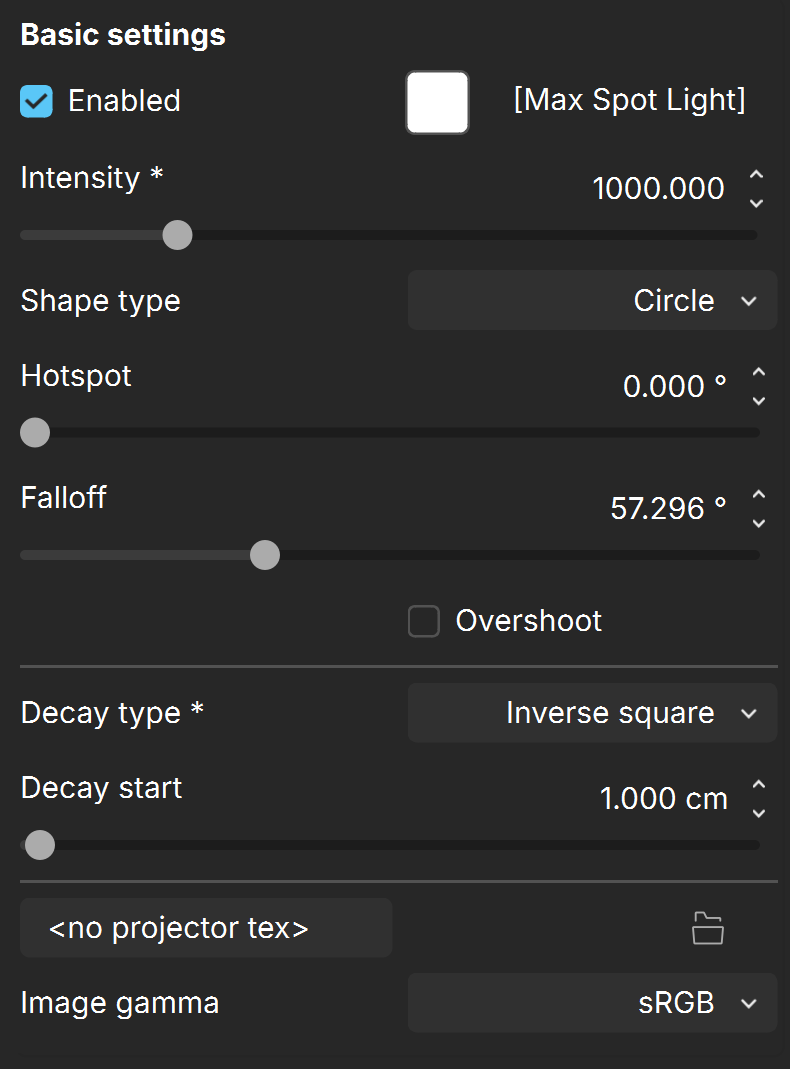
Basic settings
Enabled – Turns on and off the spot light.
Color – Changes the color of the spot light. See the Color example below.
Intensity – Specifies the intensity of the spot light's brightness.
Shape type – Specifies the shape area from which the light casts rays. See the Shape Type example below.
Circle – Sets a circle shape for the light.
Rectangle – Sets a rectangle shape for the light.
Smooth rectangle – Sets a rectangle shape with rounded corners for the light.
Hotspot – Specifies the angle of a spot light's cone in degrees. See the Hotspot example below.
Falloff – Specifies the angle of a light's falloff in degrees. See the Falloff example below.
Rect. aspect – Specifies the aspect ratio for the rectangular shape when Shape type is Rectangle or Smooth rectangle.
Overshoot – When enabled, the light casts light in all directions. Texture projections and shadows occur only within its falloff cone. See the Overshoot example below.
Decay type – Sets the type of decay (reduction of a light's intensity over distance) to use for the light. See the Decay Type example below.
None – No decay is applied and the light maintains full strength to infinity unless Far attenuation is enabled.
Inverse – Applies a slow, forgiving falloff to the light, i.e., a gradual, soft, and aesthetically pleasing decrease in light intensity as it moves away from the light source. If you double the distance from the light source, the brightness is reduced in half. The decrease in the intensity can be calculated by the formula luminance=R0 /R where R0 is the Near attenuation end value of the light if enabled, and R is how far the surface is from that point (R0).
Inverse square – Applies a fast, physically accurate falloff to the light that matches the real-world light behavior. If you double the distance from the light source, the brightness is reduced 4 times. The decrease in the intensity can be calculated by the formula luminance=(R0 /R)2 where R0 is the Near attenuation end value of the light if enabled, and R is how far the surface is from that point (R0).
Decay start – Specifies the distance at which the light begins to decay. Value is ignored if Near attenuation is enabled. See the Decay Start example below.
Projector tex – Specifies the texture to be used for color projection.
Load projector texture – Opens a browse window to load the texture to be used for projection.
Image gamma – Specifies the color space for the loaded Projector tex.
sRGB – Sets the loaded projector texture to be interpreted in sRGB color space.
Linear – Sets the loaded projector texture to be interpreted in Linear color space.
Attenuation settings
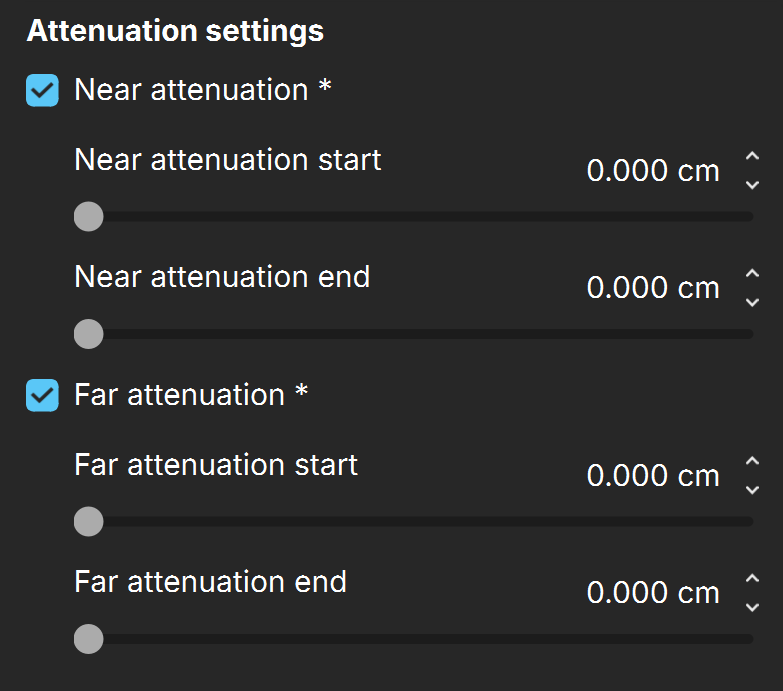
Near attenuation – Toggles near decay on and off.
Near attenuation start – Determines where the fade in starts. Anything before this point is rendered dark.
Near attenuation end – Determines where the fade in ends. After this threshold, the light is at its full value.
Far attenuation – Toggles far decay on and off.
Far attenuation start – Determines where the fade off starts.
Far attenuation end – Determines where the light reaches a value of 0, i.e. completely fades off.
Shadow settings
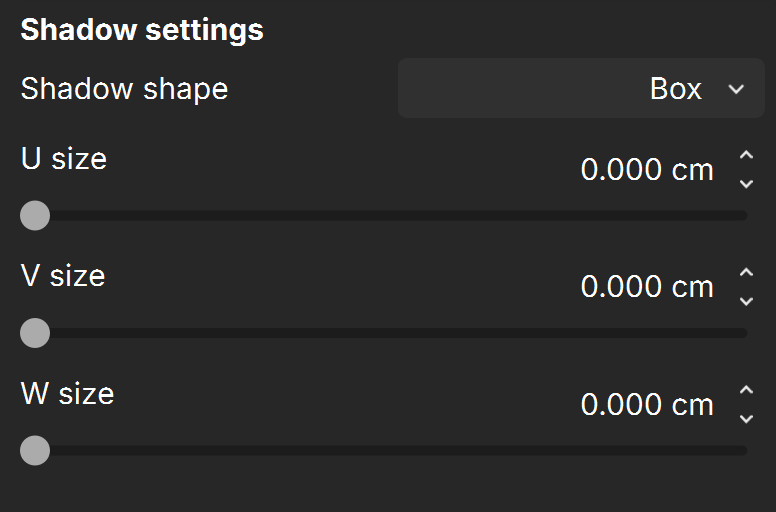
Shadow shape – Specifies the shape for the light from which shadow rays are cast.
Box – Sets a box shape the light.
Sphere – Sets a sphere shape the light.
U size – Specifies the length of the box shape when Shadow shape is Box or the diameter of the sphere Shadow shape is Sphere.
V size – Specifies the width of the box shape when Shadow shape is Box.
W size – Specifies the height of the box shape when Shadow shape is Box.
Advanced settings
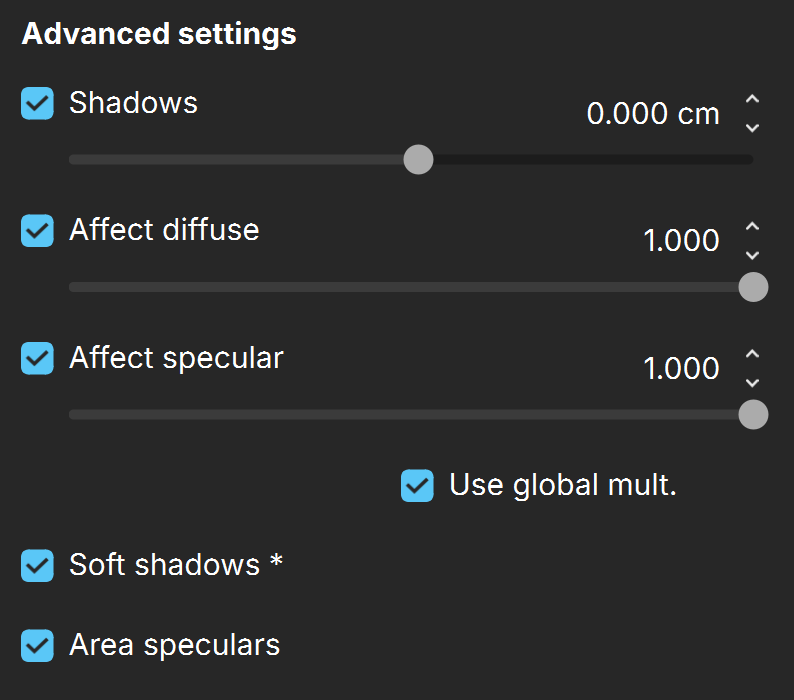
Shadows – When enabled (the default), the light casts shadows. Turn this option off to disable shadow casting for the light. The value moves the shadow toward or away from the shadow-casting object(s). Higher values move the shadow toward the object(s), while lower values move it away. If this value is too extreme, shadows can "leak" through places they shouldn't or "detach" from an object. Other effects from extreme values include Moire patterns, out-of-place dark areas on surfaces, and shadows not appearing at all in the rendering.
Affect diffuse – Determines whether the light affects the diffuse portion of the materials. The value controls the light's contribution to the diffuse portion of the materials. See the Affect Diffuse example below.
Affect specular – Determines whether the light affects the specular portion of the materials. The value controls the light's contribution to specular reflections.
Use global mult – When enabled, uses the Enable Lights value (Render tab > Advanced mode > Lighting rollout) as a multiplier to Intensity value. When disabled, the light is independent from the global multiplier.
Soft shadows – When enabled, the light shape is considered for illumination and the light is going to generate soft shadows. When disabled, the light is going to generate sharp shadows.
Area speculars – When enabled, the shape of the light is visible in the specular reflections. When disabled, the particular light is rendered as a point light in the specular reflections.
Include/Exclude Lists
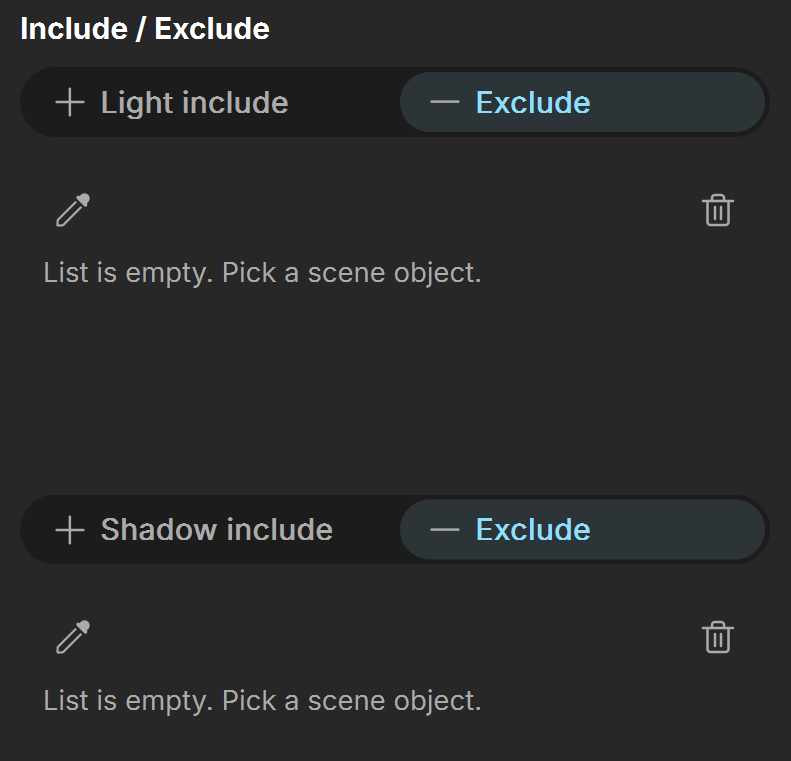
Light include/exclude – Specifies a list of objects to be included in or excluded from illumination. Objects are added to the list using the Pick scene object(s) tool.
Shadow include/exclude – Specifies a list of objects to be included in or excluded from shadow-casting. Objects are added to the list using the Pick scene object(s) tool.
Pick scene object(s) () – Selects objects and adds them to the include/exclude list.

Delete selected object(s) from the list () – Removes the selected objects from the include/exclude list.
Examples
The following examples demonstrate the effect that individual Spot Light parameters have on the scene. Click on any image to view it at a higher resolution.
Color
This example shows the effect of the Color parameter.

Color is red
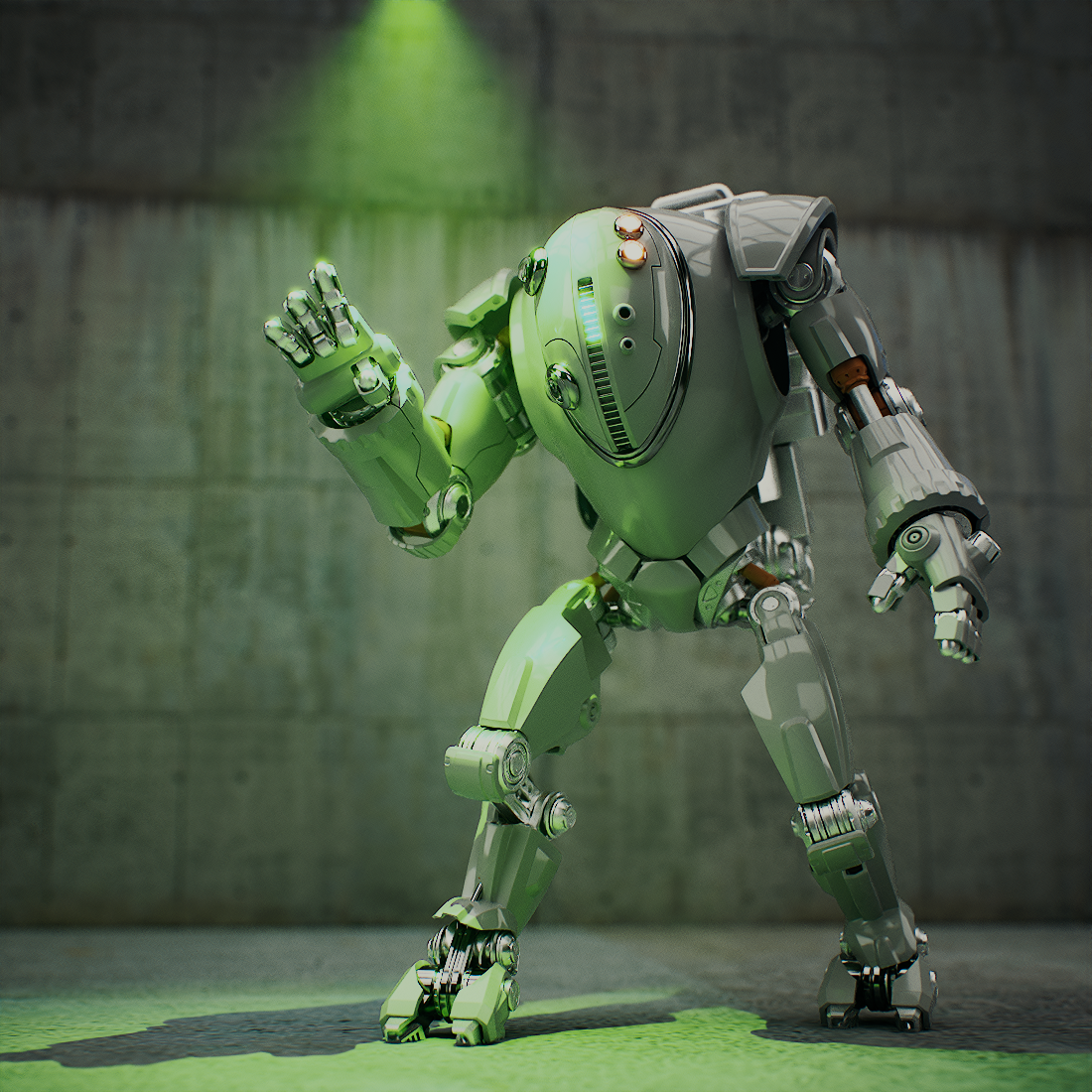
Color is green

Color is blue
Shape Type
This example shows the effect of the Shape type parameter.

Shape type = Circle

Shape type = Rectangle

Shape type = Smooth rectangle
Hotspot
This example shows the effect of the Hotspot parameter.

Hotspot = 0

Hotspot = 10

Hotspot = 45
Falloff
This example shows the effect of the Falloff parameter.

Falloff = 10

Falloff = 45

Falloff = 90
Decay Type
This example shows the effect of the Decay type parameter.

Decay type = None

Decay type = Inverse

Decay type = Inverse square
Decay Start
This example shows the effect of the Decay start parameter.

Decay start = 1

Decay start = 3
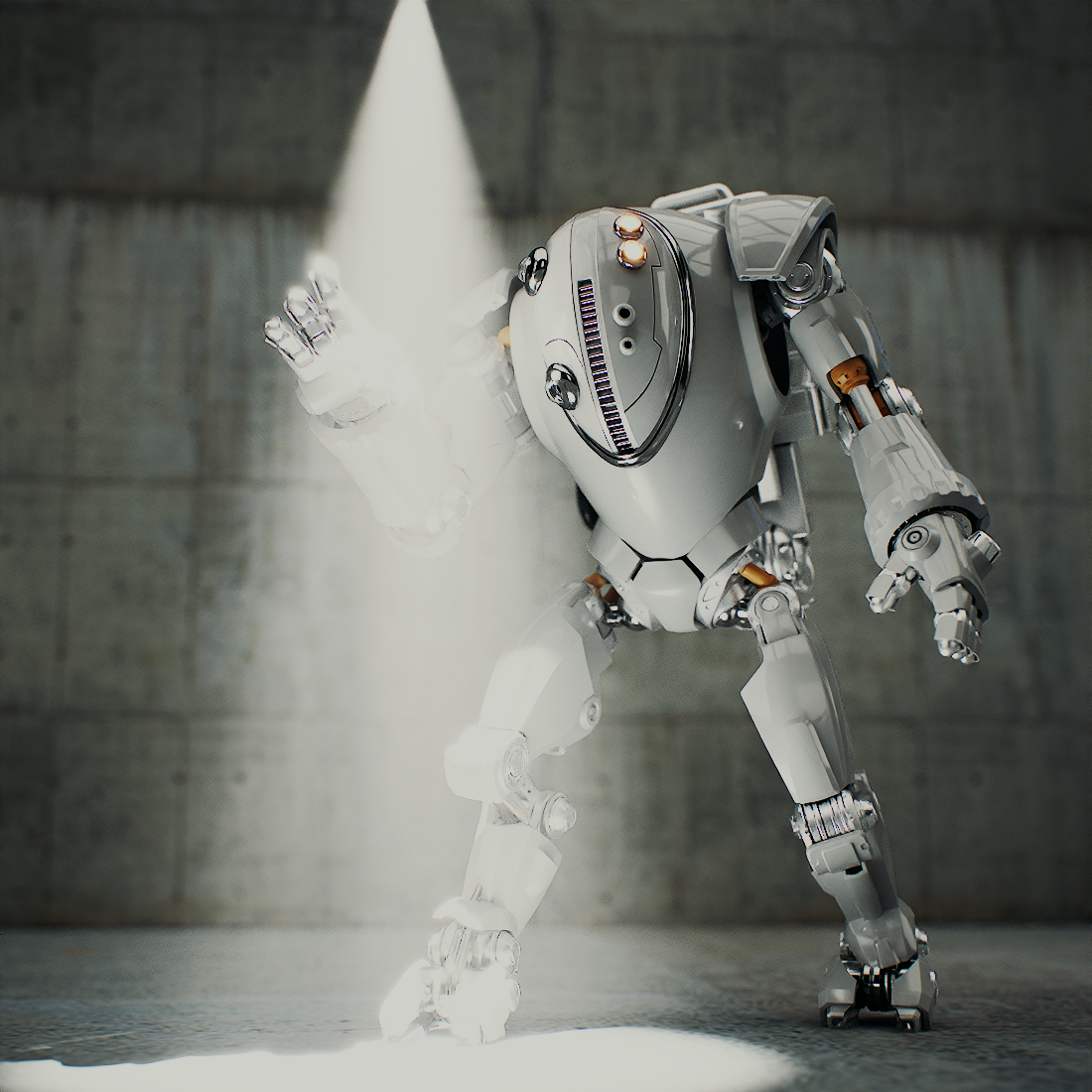
Decay start = 5
Overshoot
This example shows the effect of the Overshoot parameter.

Overshoot is off

Overshoot is on
Affect Diffuse
This example shows the effect of the Affect diffuse parameter.

Affect diffuse is off

Affect diffuse is on