V-Ray for Maya
Installation
This page provides information about V-Ray for Maya installation.
Last updated 11 July 2026
This page provides information about V-Ray for Maya installation.
Overview
This guide provides steps on installing V-Ray for Maya.
Trial users should refer to the Trial installation of V-Ray for Maya, as the process differs from the one shown here.
Refer to this page if you use the Personal Learning Edition of V-Ray for Maya.
The V-Ray installer can be unpacked and used as a portable version.
Please check the system requirements before installation. The V-Ray installer will automatically remove any previous versions.
OS Specifics
Windows
macOS
Linux
Before running the installation, make sure your Windows account has administrative privileges.
Run the installer. Windows may ask you for permission to run the installer with administrator privileges. Please confirm.
Before running the installation, make sure your macOS account has administrative privileges.
Mount the downloaded .dmg file by double-clicking it and running the V-Ray Installer.
Follow the instructions of the installer.
Open a terminal and navigate to the location where the installation file was saved (vray_install_dir in the example below).
Ensure you have permitted the Installer to run as an executable. That is done with the command chmod +x.
Follow the instructions of the installer.
<code data-v-c2b1f83f=""><span data-v-c2b1f83f="" class="line"># For example:</span><span data-v-c2b1f83f="" class="line">$ cd vray_install_dir </span><span data-v-c2b1f83f="" class="line">$ chmod +x vray_adv_60000_maya2022_centos7</span><span data-v-c2b1f83f="" class="line">$ ./vray_adv_60000_maya2022_centos7</span><span data-v-c2b1f83f="" class="line"># Follow installer instructions </span><span data-v-c2b1f83f="" class="line">$ exit</span></code>
Open a terminal and navigate to the location where the installation file was saved (vray_install_dir in the example below).
Follow the instructions of the installer.
Some Linux GUI distributions may not be compatible with the installer's GUI. In that case, run the installation with the -gui=0 attribute.
<code data-v-c2b1f83f=""><span data-v-c2b1f83f="" class="line"># For example:</span><span data-v-c2b1f83f="" class="line">$ cd vray_install_dir </span><span data-v-c2b1f83f="" class="line">$ chmod +x vray_adv_60000_maya2022_centos7 -gui=0</span><span data-v-c2b1f83f="" class="line">$ ./vray_adv_60000_maya2022_centos7</span><span data-v-c2b1f83f="" class="line"># Follow installer instructions </span><span data-v-c2b1f83f="" class="line">$ exit</span></code>
Running the Installer
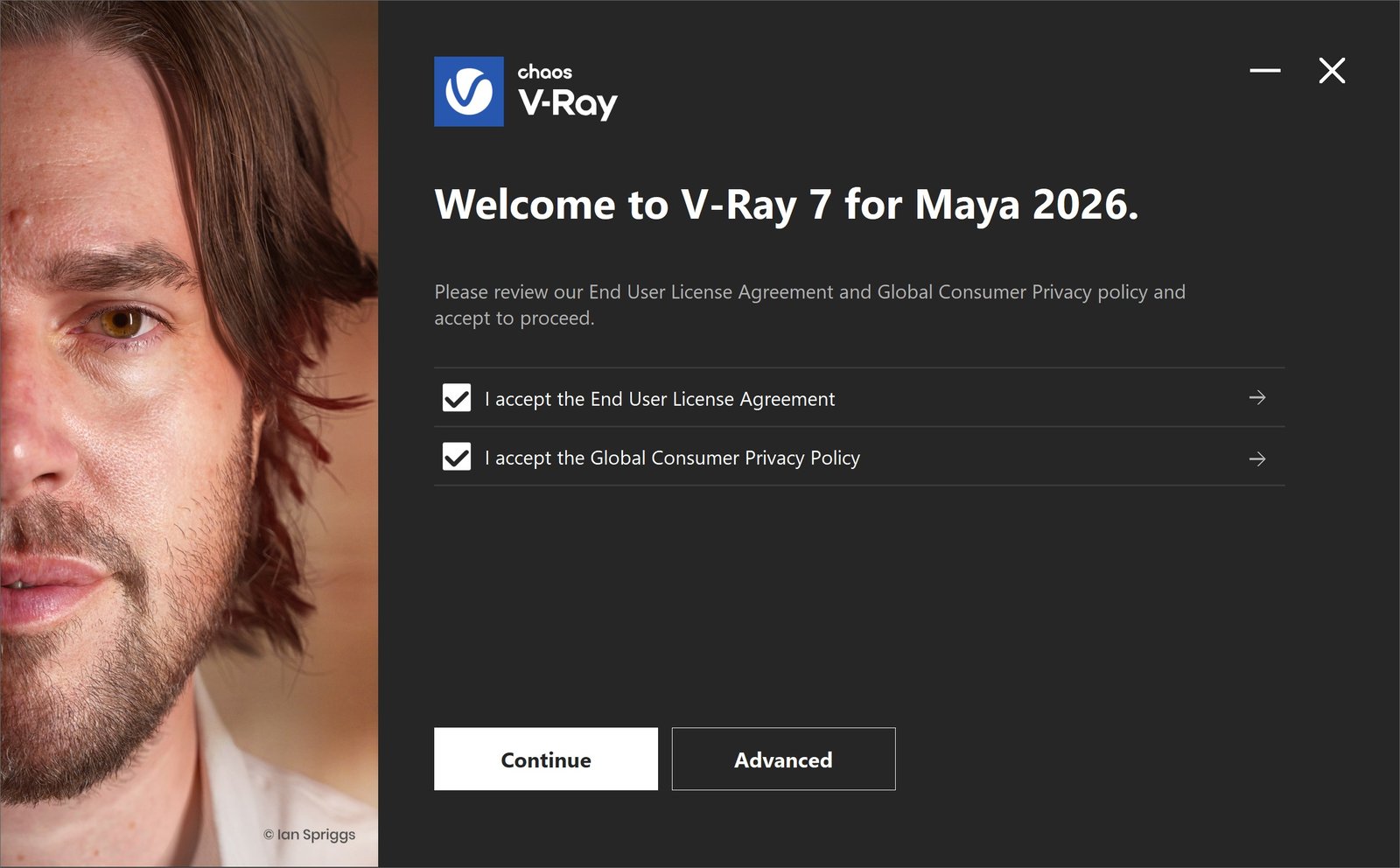
1. Welcome
Carefully read and accept the End User License Agreement and the Global Consumer Privacy Policy.
Then, click Continue. If you need to customize your V-Ray installation, click Advanced.
2. Cloud Licensing
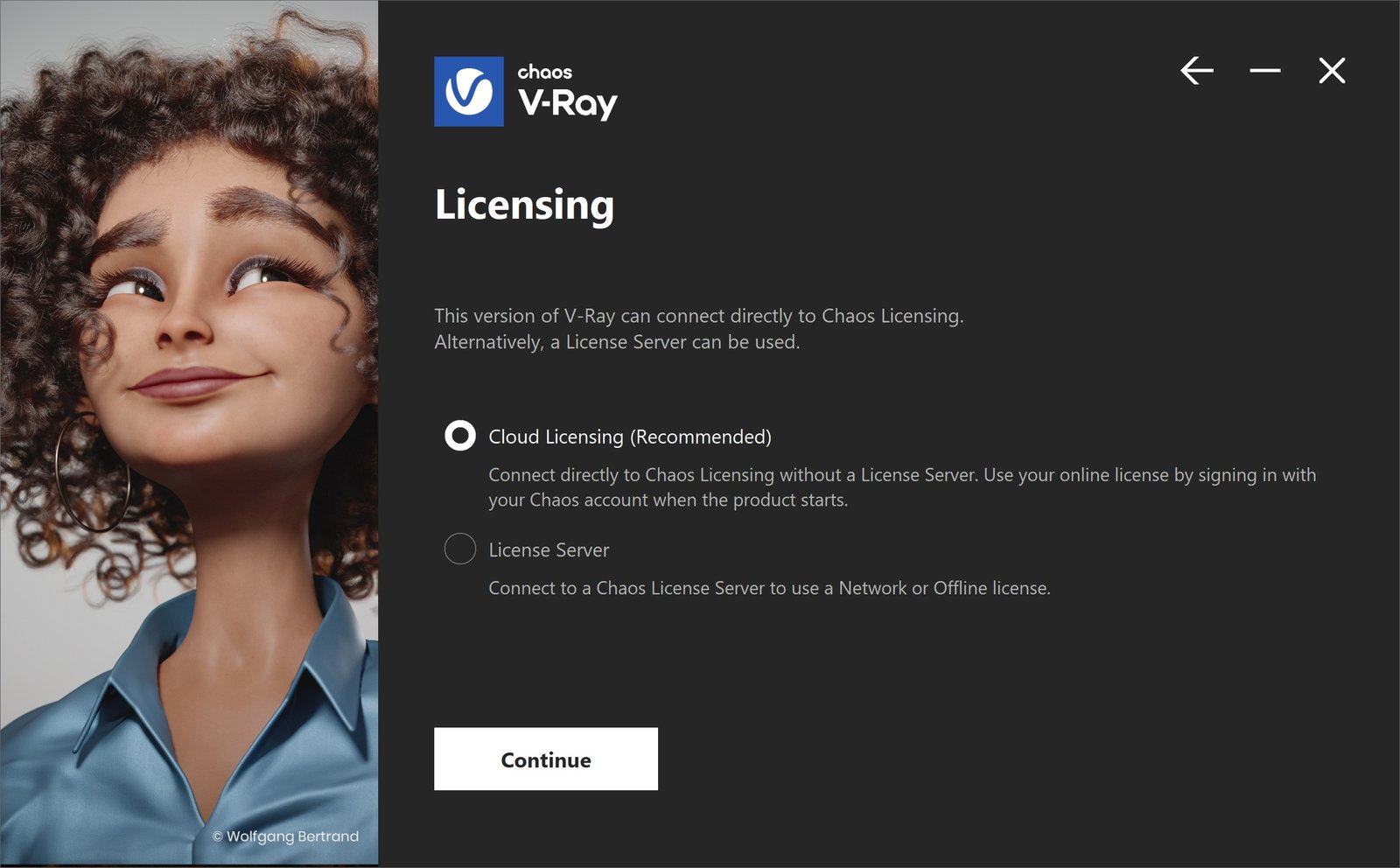
When installing for the first time, V-Ray uses Cloud Licensing by default.
Click Install to continue with Cloud Licensing. If you need to connect to a network License Server, click Use License Server.
Chaos products use two licensing models: Cloud Licensing and the License Server. Cloud Licensing offers maximum flexibility, allowing users to sign in with their Chaos Account and use products from any location with an Internet connection. The License Server allows to set up centralized network setups and requires you to be on the same local network or connect through a VPN.

3. Chaos Telemetry
V-Ray installation is successful.
Participate in the improvement decisions for future versions of V-Ray. No intellectual property is violated when agreeing to participate in the improvement program. Chaos does not gather scenes, assets, materials, etc. This preference can be changed anytime from V-Ray Render Settings > Settings > About V-Ray > Feedback program settings. For more information, see the Chaos Telemetry page.
Anonymized Telemetry – Includes the most used product functionality and/or parameter values. The data is not personally identifiable and is not tied to the user's individual account.
Personalized Telemetry – Includes the most used product functionality, parameter values, but also contains personally identifiable information tied to an individual user's license. This helps Chaos tailor and optimize the product for better personal use.

Advanced Installation Settings
After reading and accepting the End User License Agreement and the Global Consumer Privacy Policy, you can customize the installation by clicking Advanced. Read this section for more details on what settings you can customize.
1. V-Ray type
The available installation types are:
- Full – This is a full installation and includes all components as described in the Overview section. It allows you to use V-Ray in Maya, do Distributed or Network Rendering, run V-Ray and V-Ray GPU render servers, use V-Ray SDK, and have V-Ray license server on this machine.
- Standalone only – This installation includes V-Ray Standalone and render server. Please choose this option if you plan to use this machine only for Distributed Rendering with V-Ray.
- Add firewall exceptions – This installation automatically adds firewall exceptions so Distributed Rendering and V-Ray Standalone can run uninterrupted.
Disable AI Features – Disables any AI features, e.g., Veras, AI Material Generator and AI Enhancer.

2. Directories & Feedback
Here, you can specify the installation paths. Please check if the default folders are correct.

3. Licensing
In this step, you can specify whether V-Ray uses Cloud Licensing - a direct connection to the Chaos Licensing Service, or the Chaos License Server.
Cloud Licensing allows you to use your product from any location with an Internet connection by signing in with your Chaos Account.
The License Server is an additional application that can be used to set up centralized network licensing and / or use offline licenses. The License Server can be installed locally on the same device as the product, or remotely - on a centrally accessible network machine within your local network.
Local – This option installs the License Server on your machine. For a walkthrough, see the Chaos License Quick Start Guide page.
Remote – This option allows you to configure your Chaos product for floating licenses in a local network. Fill in the IP address of the Chaos License Server in your network in the Primary License Server field. Please leave the port 30304 unchanged. For more details on this setup, see the License Server Deployment page.

4. Chaos License Server Options
At this step, you can choose where to install the Chaos License Server.
Add firewall exception – Allows the default licensing port (TCP 30304) in the firewall. If you disable it at this step, you must manually add firewall exceptions later. This option is available for Windows OS only.
