V-Ray for Maya
VRaySun
This page gives details on how the physical sun and sky system works in V-Ray.
Last updated 2 July 2026
This page gives details on how the physical sun and sky system works in V-Ray.
Overview
The VRaySun and VRaySky are special features that are provided by the V-Ray renderer. Developed to work together, the VRaySun and VRaySky reproduce the real-life sun and sky environment of the Earth. Both are coded so that they change their appearance depending on the direction of the VRaySun.
The VRayGeoSun node enables you to specify the position of the V-Ray Sun for a particular location in the world at a specific time.
The VRaySun is frequently used in conjunction with the environment texture map, VRaySky.
The V-Ray Sun and Sky systems are mainly based on the SIGGRAPH 1999 paper A Practical Analytic Model for Daylight [1]. For a complete list of references, please see the References section.
Note that for the Clouds to work with VRaySun, a VRaySky is required.
UI Paths


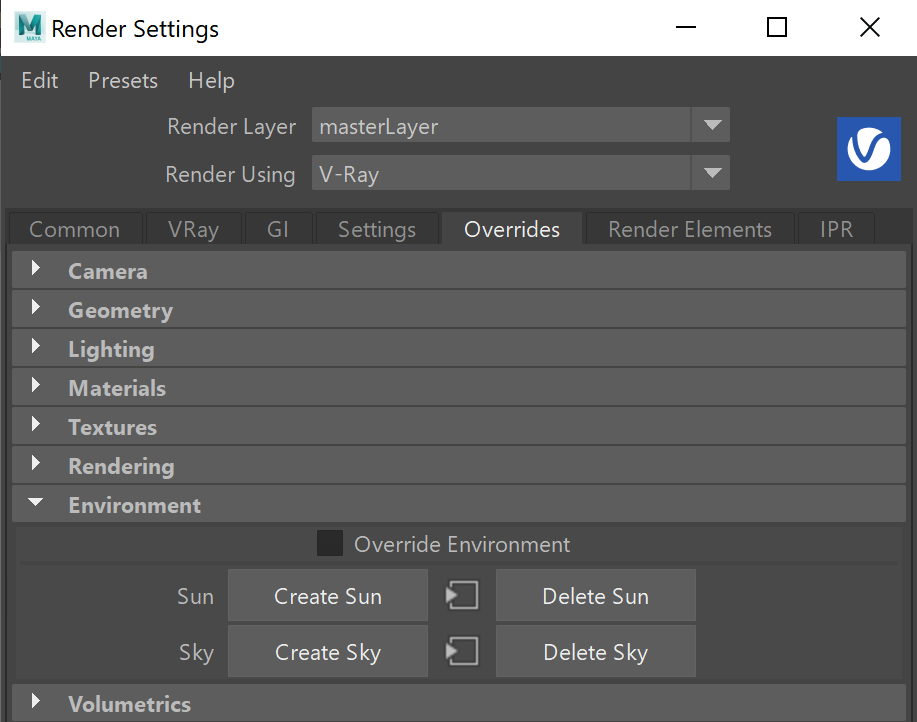


Image © Colorbleed
Parameters
After the sun is created, its parameters appear in the Attribute Editor.
Enabled – Turns the sunlight on and off.
Intensity multiplier – The brightness of the sun. Since the sun is very bright by default, you can use this parameter to reduce its effect. See the Notes section for more information. For more information, see the Intensity Multiplier example.
Turbidity – Determines the amount of dust in the air, which in turn affects the color of the sun and sky. Smaller values produce a clear, blue sky and sun, similar to what is seen in rural areas, while larger values make the sun and sky appear more yellow and orange, as seen in a big city. For more information, see the Turbidity example below. The minimum value possible is 1.81, and the maximum value is 4.89.
Ozone – Affects the color of the sunlight. Available in the range between 0.0 and 1.0. Smaller values make the sunlight more yellow, while larger values make it bluer. For more information, see the Ozone example below.
Size multiplier – Controls the visible size of the sun. This affects the appearance of the sun disc as seen by the camera and reflections, as well as the blurriness of the sun’s shadows. For more information, see the Size Multiplier example.

Sky Model – Determines the procedural model used to generate the VRaySky texture. See the Sky model example for more information.
Hosek et al. – The VRaySky procedural texture is generated based on the Hosek et al. method.
Preetham et al. – The VRaySky procedural texture is generated based on the Preetham et al. method.
CIE Clear – The VRaySky procedural texture is generated based on the CIE method for a clear sky.
CIE Overcast – The VRaySky procedural texture is generated based on the CIE method for a cloudy sky.
PRG Clear Sky – The V-Ray Sky procedural texture is generated using the PRG Clear Sky method. The updated PRG Clear Sky allows for rendering the sky at various observer altitudes, up to several kilometers. It also supports rendering of nautical twilight effects with sun positions up to 12 degrees below the horizon. Additionally, it features enhanced turbidity control, enabling the rendering of sky conditions with turbidity values ranging from 1.81 to 4.89. See the PRG Clear Sky examples.
Horiz Illumination – Specifies the intensity (in lx) of the illumination on horizontal surfaces coming from the sky. This parameter is enabled when one of the CIE Sky Models is selected.
Color Mode – This mode affects the way the Filter Color hues the sun and sky light.
Filter – Shifts the V-Ray Sun and Sky hue towards the color specified by the Filter Color.
Direct – Takes the Filter Color for the V-Ray Sun light. In this case, the light intensity is controlled by the Intensity multiplier, and it does not depend on the Sun's position in the sky.
Override – Takes the Filter Color for the V-Ray Sun light; however, the intensity is controlled by the position of the V-Ray Sun in the sky.
Filter Color – Shifts the hue of the V-Ray Sun and Sky system towards the specified color.
Ground Albedo – Sets the color of the V-Ray Sun and Sky system's ground.
Blend Angle – Specifies the angle in degrees where blending will occur between the horizon line and sky. Values close to 0.0 produce a sharper horizon line, while larger values produce a softer horizon line.
Horizon Offset – Allows the user to lower the horizon line manually.
Altitude – Controls the observer's altitude in meters. As the altitude increases, sky clarity improves, and the horizon line becomes less defined.
Night Blueness – Controls how black the sky is in a complete night. A value of 0 makes the sky completely black, while a value of 1 makes the sky slightly blue. Night blueness controls how the sky behaves for solar elevations lower than -12°. If Night Blueness is set to 0, when the Sun goes from -12° to -18°, the sky fades into complete black. By increasing the value of the Night Blueness, the black is being replaced with increasingly blue sky. If the Night Blueness is set to 1, the sky at -18° and lower looks the same as for -12°, but without the orange wedge on the horizon caused by the Sun.
Example: Intensity Multiplier
The Intensity Multiplier of the V-Ray Sun adjusts the brightness of the Sun in the scene. The Sun’s height also influences this in the scene. To simulate the way the sun actually works, the closer the V-Ray Sun is to the horizon, the warmer the color and the less bright it will appear in the render. As you raise it, the color will appear cooler (or bluer) and brighter, similar to mid-day light. In the example renders below, the common settings are Turbidity: 3.3 and Size multiplier: 3.0 (which does not change the brightness), while the height (from the horizon) and Intensity Multiplier are adjusted.

Sun Height 45°; Intensity 0.5

Sun Height 45°; Intensity 1

Sun Height 45°; Intensity 3
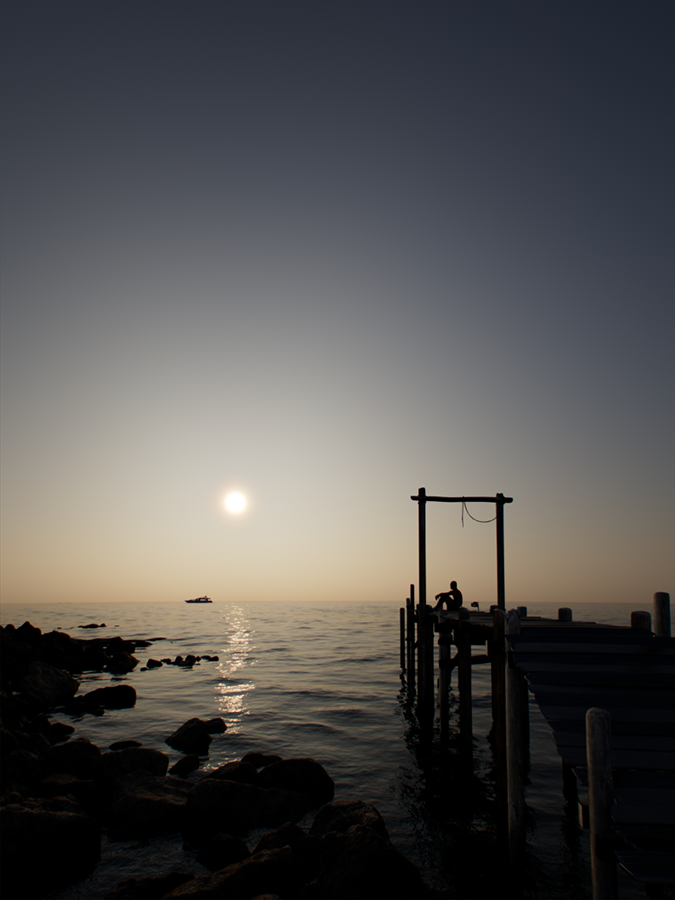
Sun Height 10°; Intensity 0.5

Sun Height 10°; Intensity 1

Sun Height 10°; Intensity 3
Example: Turbidity and Sun Height
Turbidity creates the look of the light from the Sun having to travel through particles in the atmosphere, like smog (when the value is increased). This example shows how the Turbidity attribute is affected by the height of the V-Ray Sun in our scene. The common settings are Intensity multiplier: 1, Size multiplier: 3, while the height and Turbidity are adjusted.
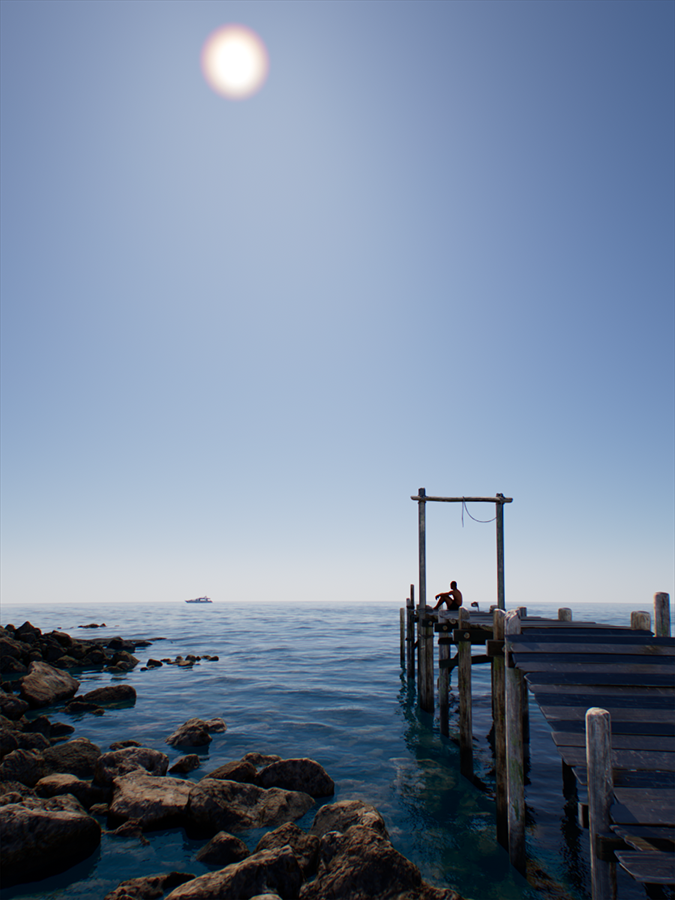
Sun Height 45°; Turbidity 1.81

Sun Height 45°; Turbidity 3.3
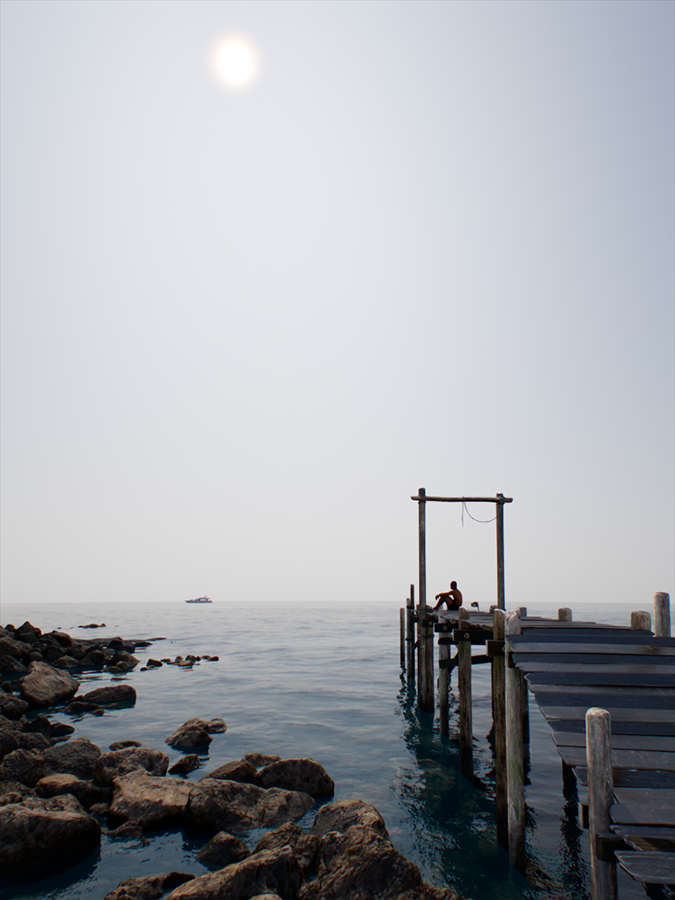
Sun Height 45°; Turbidity 4.89

Sun Height 10°; Turbidity 1.81

Sun Height 10°; Turbidity 3.3
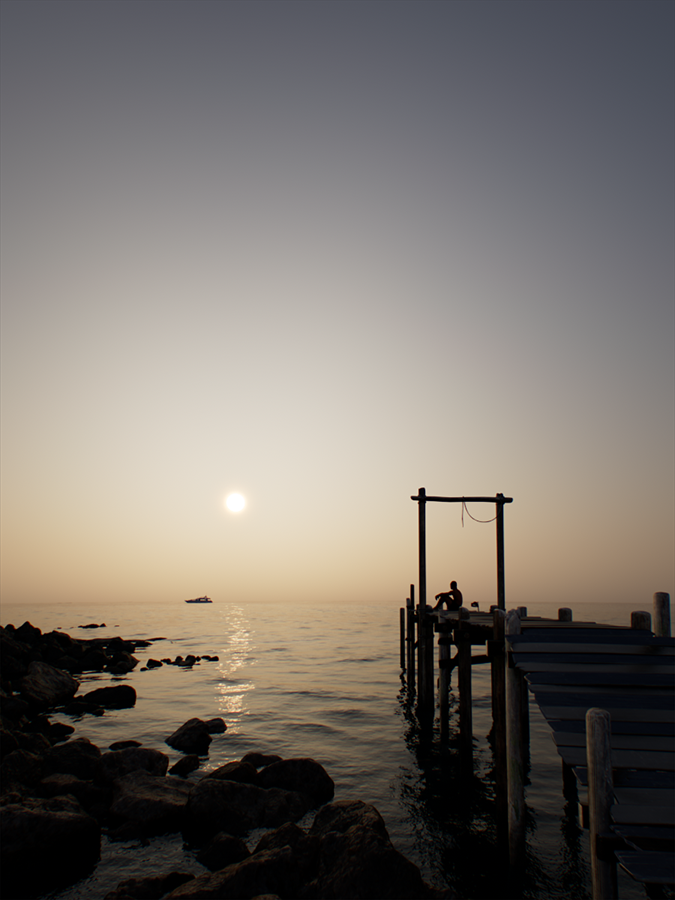
Sun Height 10°; Turbidity 4.89
Example: Size multiplier (Size & Area shadows effect)
The Size multiplier does not affect the brightness of the V-Ray Sun. As shown earlier, the Intensity multiplier is adjusted to change the brightness of the light coming from the Sun. The Size multiplier does, however, change the visual representation of the Sun when it's seen in the render, and just like with other (physically accurate) lights, the larger they are, the softer the shadows cast by that light are. Increasing this attribute as the height of the sun is lowered can also help in the realism of your renders. In the following example, the height of the Sun and the Size multiplier are adjusted, while values for attributes, such as the Intensity multiplier (set to 1.0), remain constant. The first series of images show how the size of the sun is displayed in the reflection of the water. The second set shows the shadows being cast on a ground plane.

Sun height at 5°,
Size multiplier
: 1.0

Sun height at 5°,
Size multiplier
: 3.0

Sun height at 5°,
Size multiplier
: 10.0

Sun height at 20°,
Size multiplier
: 1.0
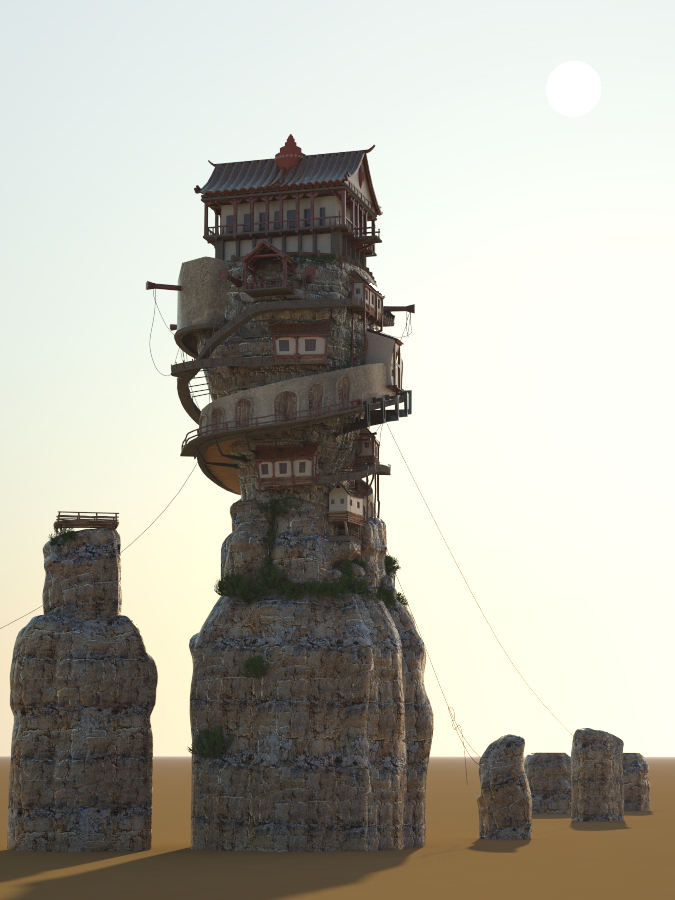
Sun height at 20°,
Size multiplier
: 3.0
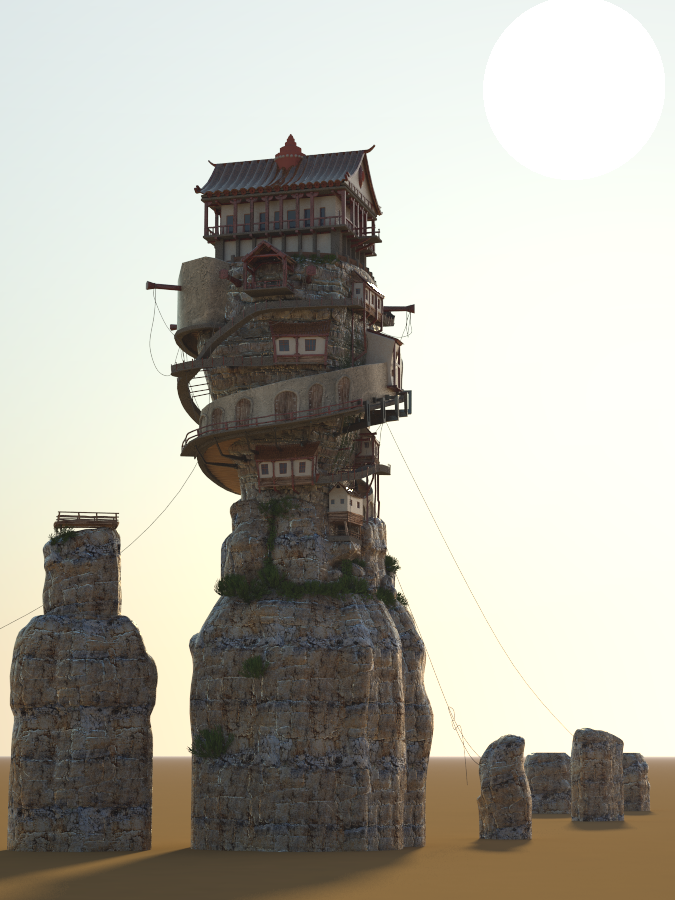
Sun height at 20°,
Size multiplier
: 10.0
Example: Ozone value
The Ozone attribute doesn't change the color of the sky, but the color of the light that hits the objects in the scene. It's a subtle effect, but it can help boost the photo-realism of your renders. In this example, the only variable adjusted is the Ozone value, while the height of the sun remains constant, and the following attributes are unchanged: Turbidity: 2.0, Intensity multiplier: 1.0, Size multiplier: 3.0.

Ozone 0

Ozone 1
Example: Sky Model
This example shows the different Sky models. The sun's position is close to the horizon, and all other parameters are at their defaults.

Preetham et al.

CIE Clear
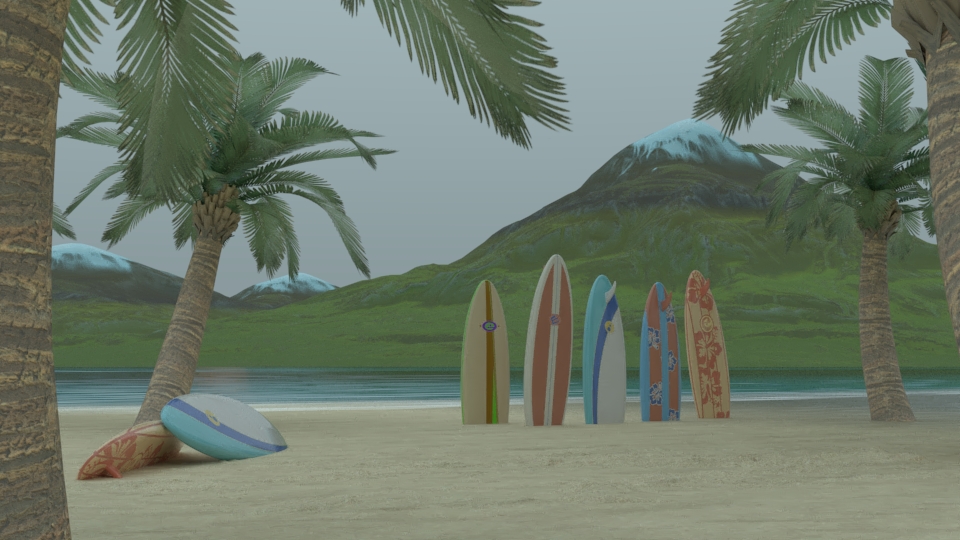
CIE Overcast

Hosek et al.

PRG Clear Sky
Example: PRG Clear Sky - Turbidity
In this example, you can see how the amount of dust in the air affects the color of the sun and sky. Smaller values produce a clear image, while higher values dim the sun and sky.
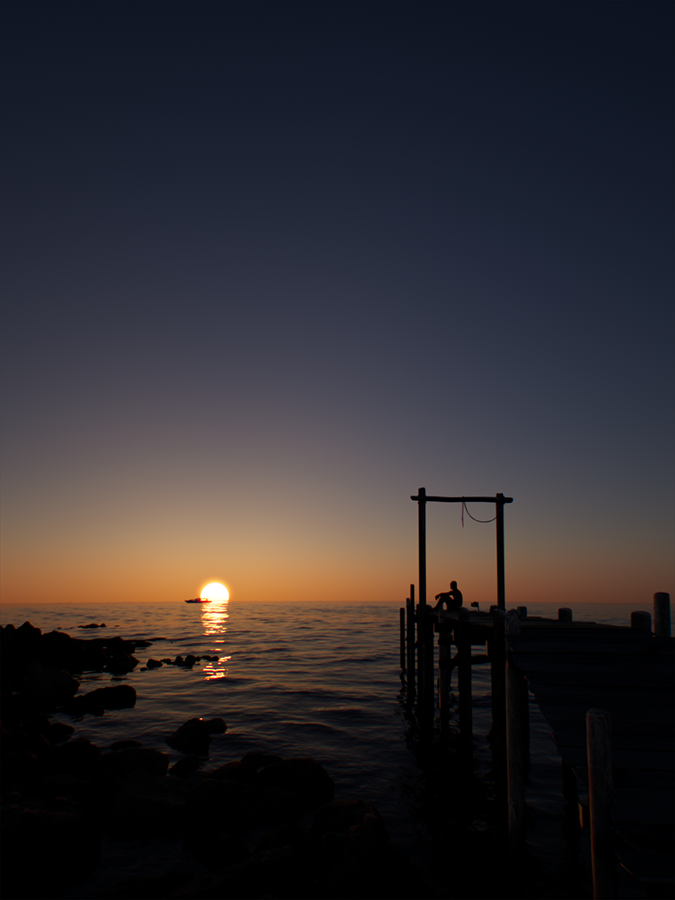
Turbidity 1.81

Turbidity 3.3

Turbidity 4.8
Example: PRG Clear Sky - Altitude
This example illustrates how altitude values impact the visualization of the sky. Higher Altitude values result in better sky clarity and a less defined horizon line.

Altitude
= 0

Altitude
= 2000

Altitude
= 15000
Example: PRG Clear Sky - Nautical twilight effect
This example shows how the sun's position affects the sky, creating a twilight effect. Changing the sun's position may also require adjusting the Exposure Value.
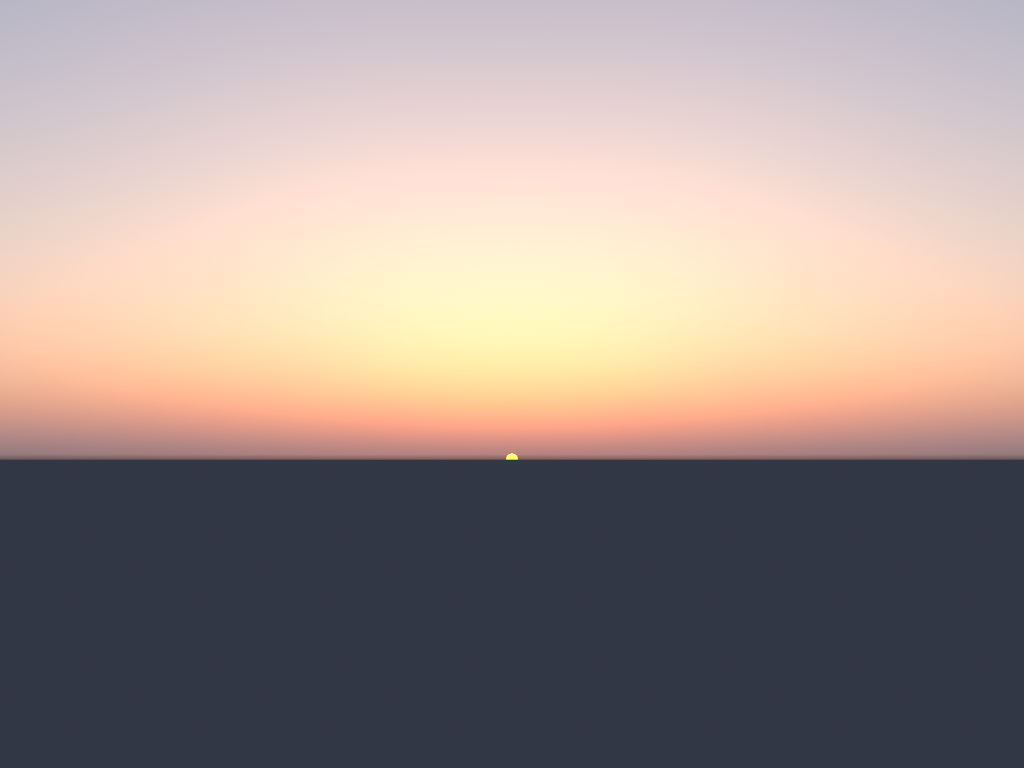
Exposure Value
= 10;
Sun below the horizon
= 0°

Exposure Value
= 10;
Sun below the horizon
= -2°

Exposure Value
= 10;
Sun below the horizon
= -4°
Shadows
Cast Shadows – When enabled, the sun produces shadows.
Cast Shadows from environment – When enabled, the sun produces shadows from volumetric effects.
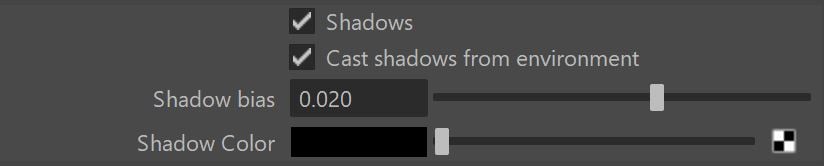
Shadow bias – Moves the shadow toward or away from the shadow-casting object (or objects). Higher values move the shadow toward the object(s) while lower values move it away. If this value is too extreme, shadows can "leak" through places they shouldn't or "detach" from an object. Other effects from extreme values include Moire patterns, out-of-place dark areas on surfaces, and shadows not appearing at all in the rendering. For more information, see the Shadow Bias example.
Shadow Color – Sets the color of the V-Ray Sun and Sky shadows. This option is inactive when using the V-Ray CUDA engine.
Example: Shadow Bias
In the example renders below, the common settings are Intensity multiplier: 1, Size multiplier: 3.0, while the Shadow bias is the only attribute adjusted between renders. The values shown in the example are highly exaggerated to help show the effect the Shadow bias has on the scene. The change in the shadow position is most noticeable on the front of the building below the roof line, where the shadow cast by the roof recedes toward the top left overhang of the roof as the Shadow bias value increases.

Shadow bias
: 0.02 (default)

Shadow bias
: 12

Shadow bias
: 24
Options
Invisible – When enabled , makes the sun invisible, both to the camera and to reflections. This is useful for preventing bright speckles on glossy surfaces where a ray with a low probability hits the extremely bright sun disk.
Affect Diffuse – Determines whether the VRaySun is affecting the diffuse properties of the materials.
Affect Specular – Determines whether the VRaySun is affecting the specular of the materials. The multiplier controls the sun’s contribution to specular reflections.
Affect Atmospherics – Determines whether the light influences the atmospheric effects in the scene.
Diffuse Contribution – A multiplier for the effect of the light on the diffuse. Smaller values result in a lesser contribution over the diffuse channel, while larger values result in a more intense light contribution. A value of 0 stops any VRaySun light contribution over the diffuse.
Specular Contribution – A multiplier for the effect of the light on the specular. Smaller values result in a lesser contribution over the specular channel, while larger values result in a more intense light contribution. A value of 0 stops any VRaySun light contribution over the specular.
Atmospherics Contribution – Determines the amount of influence the light has on the atmospheric effects, such as VRayEnvironmentFog, VRayVolumeGrid, or Phoenix effects. Smaller values result in less contribution over the atmospherics, while larger values result in more intense light contribution. A value of 0 stops any VRaySun light contribution over the atmospheric effects.

Photon Emission
Photon radius – Determines the radius of the area in which photons will be shot. This area is represented by the cylinder around the Sun's ray vector. This parameter has an effect when photons are used in the GI solutions or caustics.
Caustics subdivs – Used by V-Ray when calculating Caustics. Lower values mean noisier results, but will render faster. Higher values produce smoother results but take more time. This option is inactive when using the V-Ray CUDA engine.
Caustics Multiplier – Used by V-Ray when calculating Caustics. This multiplier controls the brightness of the caustics. This option is inactive when using the V-Ray CUDA engine.

Clouds and Night Sky
Clouds and Night Sky features of VRaySun can be found on the Clouds and Night Sky page.
V-Ray Sky Texture
For more information on the Sky portion of the V-Ray Sun and Sky System, please see the Sky Map (VRaySky) page.
VRayGeoSun
The VRayGeoSun node is automatically created when a VRaySun node is created. For more information, visit the VRayGeoSun page.
Notes
- By default, the VRaySun and VRaySky are very bright. In the real world, the average solar irradiance is about 1000 W/m^2 (see the references below). Since the image output in V-Ray is in W/m^2/sr, you will typically find that the average RGB values produced by the sun and the sky are about 200.0-300.0 units. This is quite correct from a physical point of view, but it is not enough for a nice image. You can either use color mapping to bring these values to a smaller range (which is the preferred method) or use the Sun's Intensity multiplier to make the sun and sky less bright. Using the VRayPhysicalCamera with suitable values also produces a correct result without changing the sun and sky parameters.
- Sun light rays that strike the scene objects are treated as parallel to one another regardless of how far the Sun object is placed from the scene objects, producing the parallel shadows that our own sun creates.
- A Sun light is designed to be used with global illumination; when the light bounces around the scene, the resulting rendering looks very much like sunlight in real life.
- A Sun light can work in conjunction with a Sky environment background to provide realistic lighting and coloring for the scene when used with GI. Often, Sun/Sky is the only lighting setup needed in the scene to produce a photo-real rendering.
- The Sun/Sky combination is suitable for an exterior scene or for an interior scene with windows or other openings through which light can pass.
- V-Ray 7 introduces the PRG Clear Sky New model, which is similar to the old PRG Clear Sky. The old PRG Clear Sky is compatible with scenes that contain suns and skies created with previous V-Ray versions. The new Sky model is also available in the dropdown menu for old scenes.
References
Here is a list of references about the V-Ray Sun and Sky implementation, as well as general information about the illumination of the Sun.
- A.J. Preetham, P. Shirley, and B. Smits, A Practical Analytic Model for Daylight, SIGGRAPH 1999, Computer Graphics Proceedings;An online version can be found at http://www.cs.utah.edu/~shirley/papers/sunsky/ (Please note that this link is no longer valid).This paper includes source code examples and serves as the basis for the VRaySun and VRaySky plugins.
- R. H. B. Exell, The intensity of solar radiation, 2000This page is available at http://www.jgsee.kmutt.ac.th/exell/IntensitySolarRad.pdf (Please note that this link is no longer valid).This document contains information about the average intensity of the solar radiation, as well as some specific measurements.
- R. Cahalan, Sun & Earth RadiationThis page can be found at http://climate.gsfc.nasa.gov/static/cahalan/Radiation/ (Please note that this link is no longer valid).These pages contain a list of accurate solar irradiances across a large portion of the electromagnetic spectrum.
- D. Robinson-Boonstra, Venus Transit: Activity 3, Sun & Earth Day 2004This document can be found online athttp://sunearth.gsfc.nasa.gov/sunearthday/2004/2004images/VT_Activity3.pdf (Please note that this link is no longer valid). Among other things, this document provides the distance from the Sun to the Earth and the size of the Sun, derived from astronomical observations.
- Hosek L, et al, An Analytic Model for Full Spectral Sky-Dome RadianceThis document can be found online athttp://cgg.mff.cuni.cz/projects/SkylightModelling/HosekWilkie_SkylightModel_SIGGRAPH2012_Preprint_lowres.pdfDescribes the Hosek sky model used by the VRaySun and VRaySky