V-Ray for Maya
VRayTexGLSL
This page provides information on the V-Ray GLSL Map.
Last updated 19 September 2025
This page provides information on the V-Ray GLSL Map.
Overview
The VRayMtlGLSL and VRayTexGLSL nodes can be used to load GLSL shaders (.frag, .glsl files) or V-Ray precompiled fragment shaders (.pfrag files) and render them directly with V-Ray. If the shader file describes a material (rather than a texture), it can be rendered with a VRayMtlGLSL material or by assigning a VRayTexGLSL map to the color slot of a VRayLightMtl material.
Note that both VRayGLSLMtl and VRayTexGLSL share the same user interface.
The VRayMtlGLSL material and the VRayTexGLSL map are part of the first stage of V-Ray implementation of GLSL support. In this version of V-Ray, the shaders are compiled to byte code for a software virtual machine, which is then interpreted. Due to this run-time interpretation, GLSL shaders can be somewhat slower to render than V-Ray shaders written in C++. In future builds of V-Ray, shaders will be directly compiled to machine code for faster rendering.
For the example on the right, four different VRayTexGLSL maps have been loaded into the diffuse channel of V-Ray Materials.
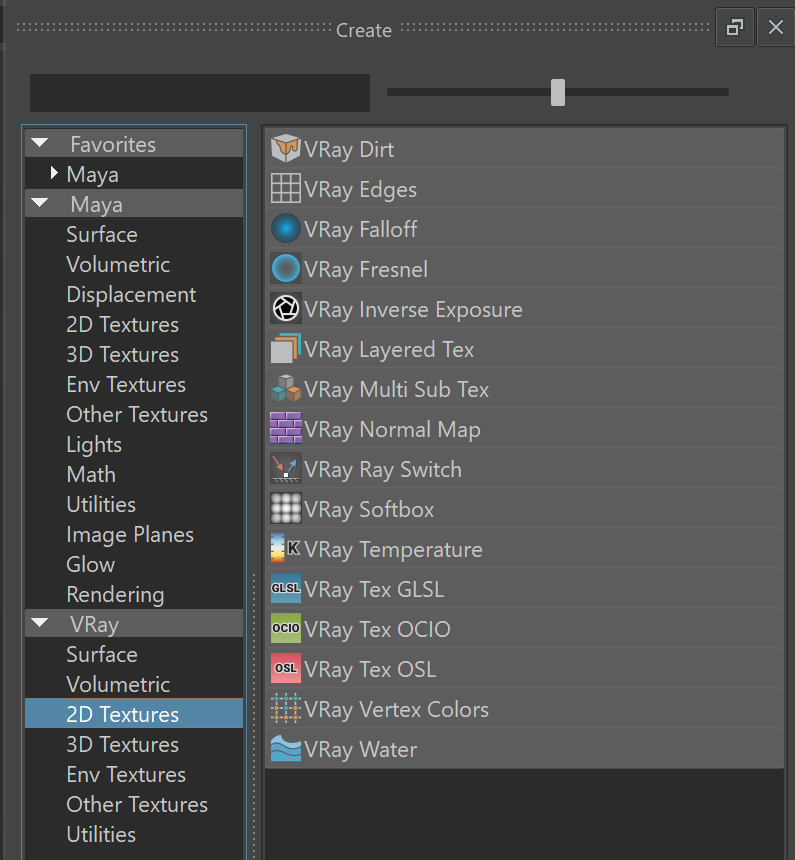
UI Path: ||Hypershade|| > Create panel > VRay section > 2D Textures > VRay Tex GLSL

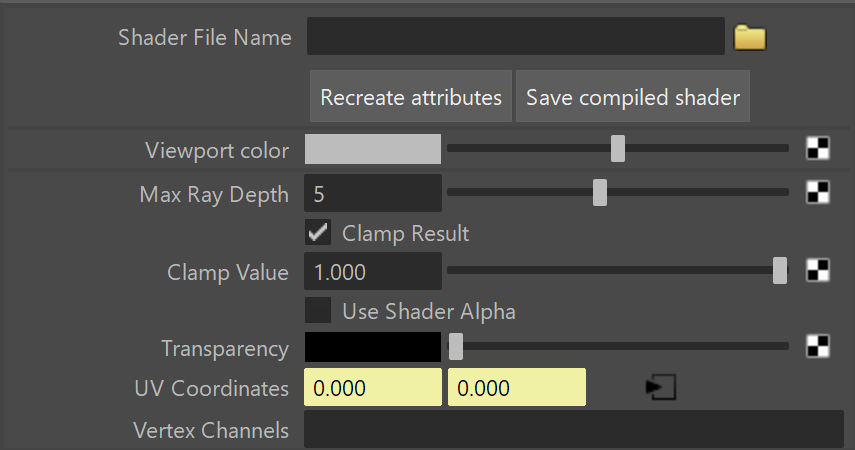
Basic Parameters
Shader File Name – Specifies the .glsl, .frag, or .pfrag file which contains the shader code.
Recreate attributes – Reloads the shader and recreate its parameters.
Save compiled shader – Saves the shader file as a binary precompiled fragment shader file (.pfrag).
Viewport color – Specifies the diffuse component of the material used in the viewport shading.
Max Ray Depth – Specifies the maximum reflection/refraction depth for the shader.
Clamp Result – Determines whether to force the result in the [0, Clamp Value] range or not.
Clamp Value – Specifies the upper clamp limit if Clamp Result is enabled.
Use Shader Alpha – When enabled, use the alpha calculated in the shader.
Transparency – Overrides the alpha if Use Shader Alpha is disabled.
UV Coordinates –
Vertex Channels –
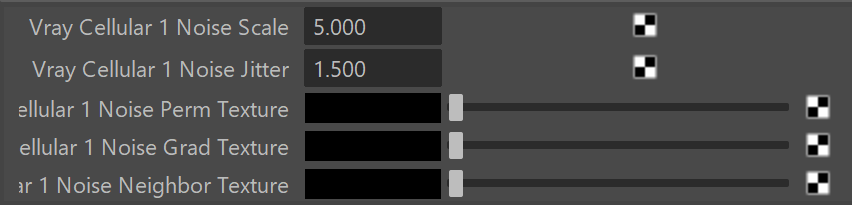
Shader Attributes
This section holds all parameters found in the shader itself and can be edited from here.
GPU Support
The GLSL shader is supported by V-Ray GPU within limitations. Below you can find detailed information about the GPU support.
Feature | GPU Support |
|---|
Feature | GPU Support |
|---|---|
Built-in variables | |
gl_NormalMatrix | Always identity matrix. |
gl_ModelViewMatrixTranspose | Always identity matrix. |
gl_TextureMatrix | Always identity matrix. |
gl_TextureMatrixInverse | Always identity matrix. |
gl_TextureMatrixInverseTranspose | Always identity matrix. |
gl_TextureMatrixTranspose | Always identity matrix. |
gl_ModelViewMatrixInverseTranspose | Always identity matrix. |
gl_FogFragCoord | Always is a zero. |
gl_TexCoord[] | All gl_TexCoord[] elements are identical, i.e. multiple UVW channels are not supported. VRayTexGLSL#1 |
Built-in functions | |
dFdx(); dFdy() | Always return zero. |
fwidth() | Always returns zero. |
V-Ray extensions to GLSL | |
vr_Velocity | Always is a zero. |
vr_NumSuperSamples | Always is 1. |
vr_SuperSampleIndex | Always is 1. |
vr_TextureDu[] | Not supported. |
vr_TextureDv[] | Not supported. |
vr_VertexData[] | Not supported. |
vr_FrameData | Only the following are supported: vr_FrameData.focalLength |
vr_trace() | Not supported. |
vr_evalLight() | Not supported. If attempted to call it will assign the following constants to the output light iterator: light.dot_nl = -1.0 |
vr_intersect() | Not supported. |
BRDF | Only the following BRDF calls are supported 2: vr_brdf_diffuse() |
Keywords | The following keywords are ignored: __channel __persistent __native |
References
- Randi J. Rost et al, OpenGL Shading Language, second edition, Addison-Wesley, 2006
- Lighthouse3D.com (link no longer active) - a useful site that describes the basics of GLSL and has many shader examples
Footnotes
1 – This is still work in progress.
2 – Experimental feature.