Corona for Cinema 4D
Corona Sky
This article explains the settings and values for the Corona Sky object in Cinema 4D.
Last updated 10 February 2026
This article explains the settings and values for the Corona Sky object in Cinema 4D.
Overview
The Corona Sky object can be used to illuminate your scene with a realistic skylight. By default, it is visible directly, in reflections and in refractions; it casts light onto the scene objects and bounces around, producing global illumination, just like in real life.
Once a combination of Corona Sky and Corona Sun is used, the sky's appearance will be automatically updated based on the sun's position, for example, casting warmer light when the sun is closer to the horizon and cooler light if the sun is in the zenith position.

Tutorial: Sun and Sky with Chaos Corona for Cinema 4D
www.youtube.com
Object Properties
Type – This parameter allows you to choose between different Sky types.
Simple color – This sky type allows you to use a solid color to represent the sky.
Physical sky – This sky type allows you to choose between different sky models to represent the sky more accurately.
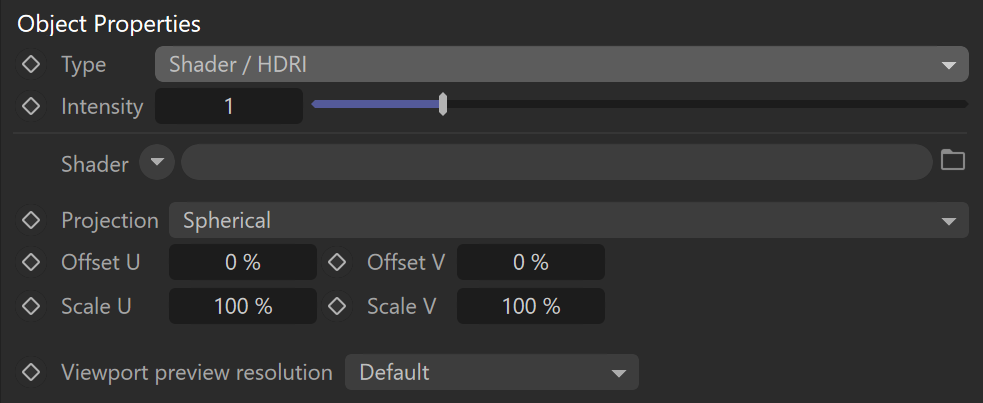
Shader / HDRI – This sky type allows you to use an HDR image to create the overall skylight in your scene project.
Intensity – This value sets the intensity of the skylight.

Sky type – Simple color
Color – This parameter allows you to set the sky color.

Sky type – Physical sky
Sky model – Sets the sky model that is used in the render.
Rawa-fake – This is a "fake" (non-physical) sky model, which allows for easier customization (the Zenith color, Horizon color, Sundisk glow, and Sun color bleed values can be changed under "Rawafake model parameters" once this model is selected).
Hosek & Wilkie – Previously, this was the most recommended and realistic sky model (in Corona Renderer 5 and older). It produces realistic results; however, it has some disadvantages compared to the PRG Clear Sky Model - for example, it does not allow rendering of the sun disk below the horizon and casts a greenish hue into the scene.
PRG Clear Sky – This model was introduced in Corona Renderer 6. It provides greater accuracy, and most importantly, the sky continues to be accurately illuminated when the sun is below the horizon, down to as low as -2.85 degrees (or approximately 5.4 sun diameters below the horizon), which enables dawn and twilight effects.
Fake horizon blur – Defines how much the horizon blurs in the render.
Ground color – Defines the color of the ground below the horizon.
Ground affected by Sky – When enabled, the ground color is assumed to be the input diffuse color of the ground material, which is multiplied by the sky irradiance. When diasabled, the ground color is the final color returned by the texture for low angles, regardless of the sky.
Celestrial selection – Defines the mode for the linking between the Corona Sky, the Corona Sun, and Corona Moon objects.
Automatic – The Corona Sky is auto-linked to the first active Corona Sun object in the scene.
Select Sun – You can manually set the Corona Sun to which the Corona Sky is linked.
Select Moon – You can manually set the Corona Moon to which the Corona Sky is linked.
Select Sun and Moon – You can manually set the Corona Sun and Corona Moon to which the Corona Sky is linked.
Sun – Defines the Corona Sun object in the scene that is used to affect the sky color when the Sun position changes.
Moon – Defines the Corona Moon object in the scene that is used to affect the sky color when the Moon position changes.

Physical Sky – Sky model

Hosek & Wilkie
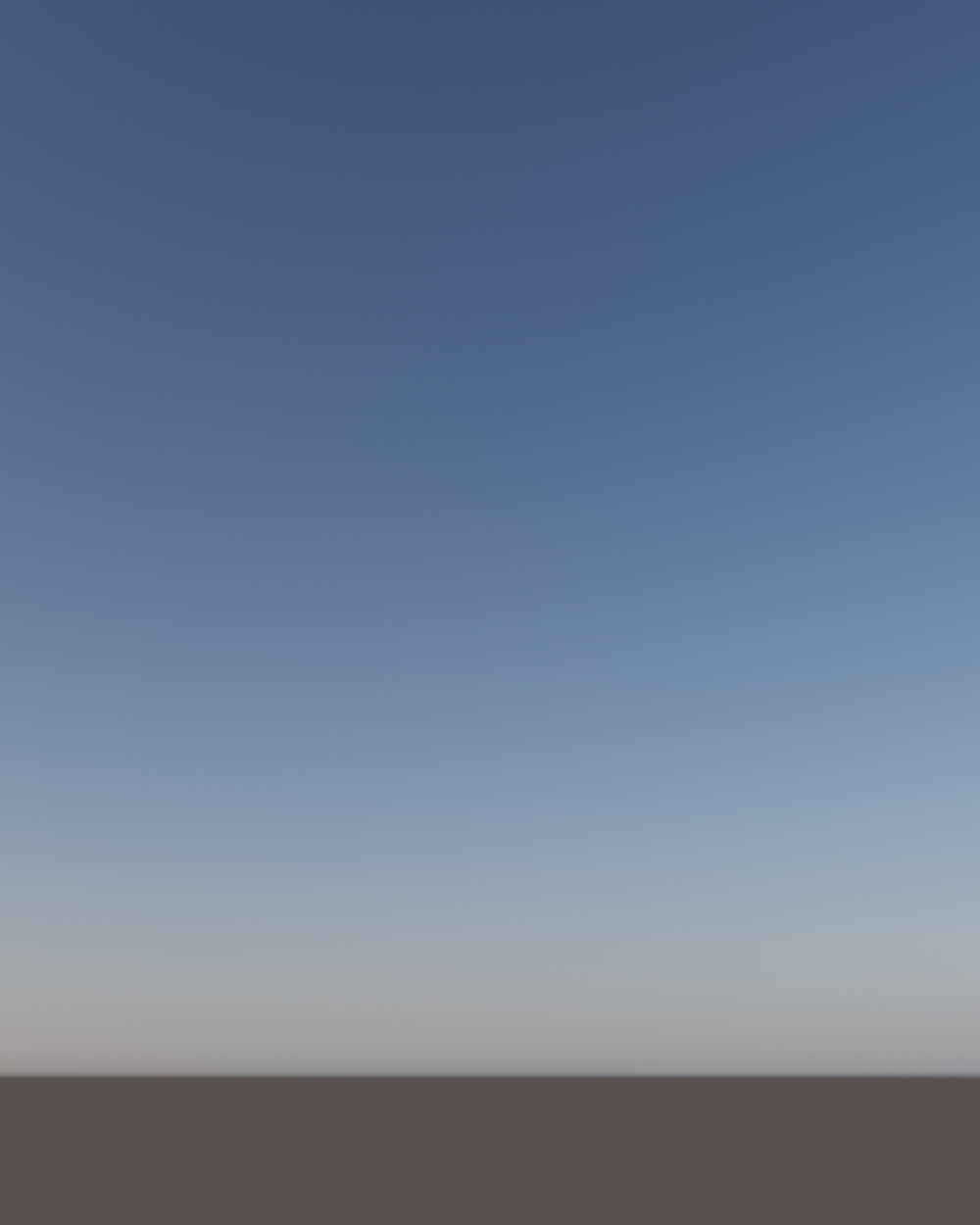
PRG Clear Sky
Physical Sky – Intensity
Intensity = 1

Intensity = 5
Physical Sky – Fake horizon blur
Fake horizontal blur = 0

Fake horizontal blur = 0.75
Physical Sky – Ground affected by Sky

Ground affected by Sky = OFF
Ground affected by Sky = ON
Sky model – PRG Clear Sky
Turbidity – Defines the number of pollutants (smog) in the atmosphere. Increasing the value makes the sky hazier, while decreasing it makes the sky clearer.
Altitude [m] – Sets the altitude at where the viewer is located. With higher values, the sky gets clearer and the horizon line less sharp.
Volume effect – The Volume Effect is based on the atmospheric settings from the Corona Sky. This creates a volumetric effect like ambiance fog/dust, also known as "Aerial perspective".
Scale – Determines the intensity of the Volume effect. Higher values make the volume effect more visible.
Alpha mode – Specifies how the volume effect is visible in the alpha channel. Available modes are:
Default – This is the default mode. In this mode, the alpha value for the volume effect is derived from its components (Turbidity, Altitude, and Scale).
Always black – In this mode, the alpha value for the volume effect is always black (the volume effect shows as transparent).
Always white – In this mode, the alpha value for the volume effect is always white (the volume effect shows as opaque).

PRG Clear Sky - Turbidity

Trubidity = 2.5

Turbidity = 7.5
PRG Clear Sky - Altitude [m]

Altitude = 100m

Altitude = 1500m
PRG Clear Sky - Volume effect

Volume effect = off

Volume effect = on
PRG Clear Sky - Scale

Scale = 0

Scale = 50
Sky model – Rawa-fake
Zenith color – Sets the overall sky color.
Horizon color – Defines the overall horizon color.
Sundisk glow – Sets the amount of glowing from the Sundisk.
Sunside glow – Sets the amount of overall ambiance glowing depending on where the Sun is located.

Rawa-fake - Horizon color

Horizon color= light blue

Horizon color = light pink
Rawa-fake - Zenith color

Zenith color = dark blue

Zenith color = purple
Rawa-fake - Sunside glow

Sunside glow = 20%

Sunside glow = 100%
Rawa-fake - Sundisk glow

Sundisk glow = 20%

Sundisk glow = 100%
Sky model – Hosek & Wilkie
Turbidity – Defines the number of pollutants (smog) in the atmosphere. Increasing the value makes the sky hazier, while decreasing it makes the sky clearer.
Hosek & Wilkie - Turbidity

Turbidity = 2.5

Turbidity = 7.5
Sky type – Shader / HDRI
Shader – Allows to define the HDR image used for the overall lighting.
Projection – Allows the selection between different projection modes for the HDR image.
Spherical
Cubic
Frontal
Dome
Offset U – Offsets the HDR image in the U coordinate.
Offset V – Offsets the HDR image in the V coordinate.
Scale U – Scales the HDR image in the U coordinate.
Scale V – Scales the HDR image in the V coordinate.
Viewport preview resolution – Allows switching between different resolution sizes for the viewport preview.
Clouds
Enable – Enables the Cloud system for the Sky.
Amount – Specifies the amount of the main clouds (stratus, cumulus, cumulonimbus). A value equal to 0% means there are no such clouds in the sky, while a value equal to 100% means the sky is full of these clouds.
Variety – Randomly changes the appearance of the main clouds.
Cirrus amount – Sets the amount of cirrus clouds (clouds high in the sky). A value equal to 0% means that no cirrus clouds are visible, while a value equal to 100% means the maximum amount of cirrus clouds in the sky.
Phase – Determines minor perturbation of the clouds to simulate their change in time.
Seed - Generates new clouds when the value is changed.
Density scale - Controls the density appearance of the main clouds. A value of 1 means no additional scaling; increasing the value leads to denser clouds while decreasing the value results in lower-density clouds.

Tutorial: Procedural Clouds with Chaos Corona for Cinema 4D
www.youtube.com
Clouds - Variety

Variety = 25%

Variety = 75%
Clouds - Amount

Amount = 25%

Amount = 75%
Clouds - Phase

Phase = 0%

Phase = 50%
Clouds - Cirrus amount

Cirrus amount = 25%

Cirrus amount = 75%
Clouds – Density scale

Density scale = 0.1

Density scale = 0.5

Density scale = 1 (default)

Density scale = 10
Clouds – Seed

Seed = 0 (default)

Seed = 5

Seed = 10

Seed = 50
Clouds Position
Altitude [m] – Controls the altitude (measured from the ground) at which the main cloud starts. Measured in meters.
Height [m] – Controls the height (thickness) of the main clouds. Increasing this value leads to heavier clouds, while decreasing it results in lighter (more transparent). Measured in meters.
Offset X [m] – Offsets clouds on the X-axis. Measured in meters.
Offset Z [m] – Offsets clouds on the Z-axis. Measured in meters.

Clouds Position - Altitude [m]
Clouds Position - Height [m]



Clouds Position - Offset X [m]
Clouds Position - Offset Z [m]


Contrails
Enabled – Enables the use of contrails for the sky.
Plane count – Controls how many planes are simulated to create contrails.
Time – Controls the simulation of time - increasing time moves planes along their travel direction. Increasing this property by larger values can be used as a random seeding of the planes positions.
Strength – Determines how many contrails are visible in the sky.
Distortion – Determines how much contrails are distorted. A value of 0% gives contrail lines without any distortions, while a value of 100% results in a maximum amount of distortion.
Offset X [m] – Offsets contrails on the X-axis. Measured in meters.
Offset Z [m] – Offsets contrails on the Z-axis. Measured in meters.

Clouds Contrails - Plane count

Plane count = 5

Plane count = 20

Plane count = 50

Plane count = 100
Clouds Contrails - Time

Time = 0
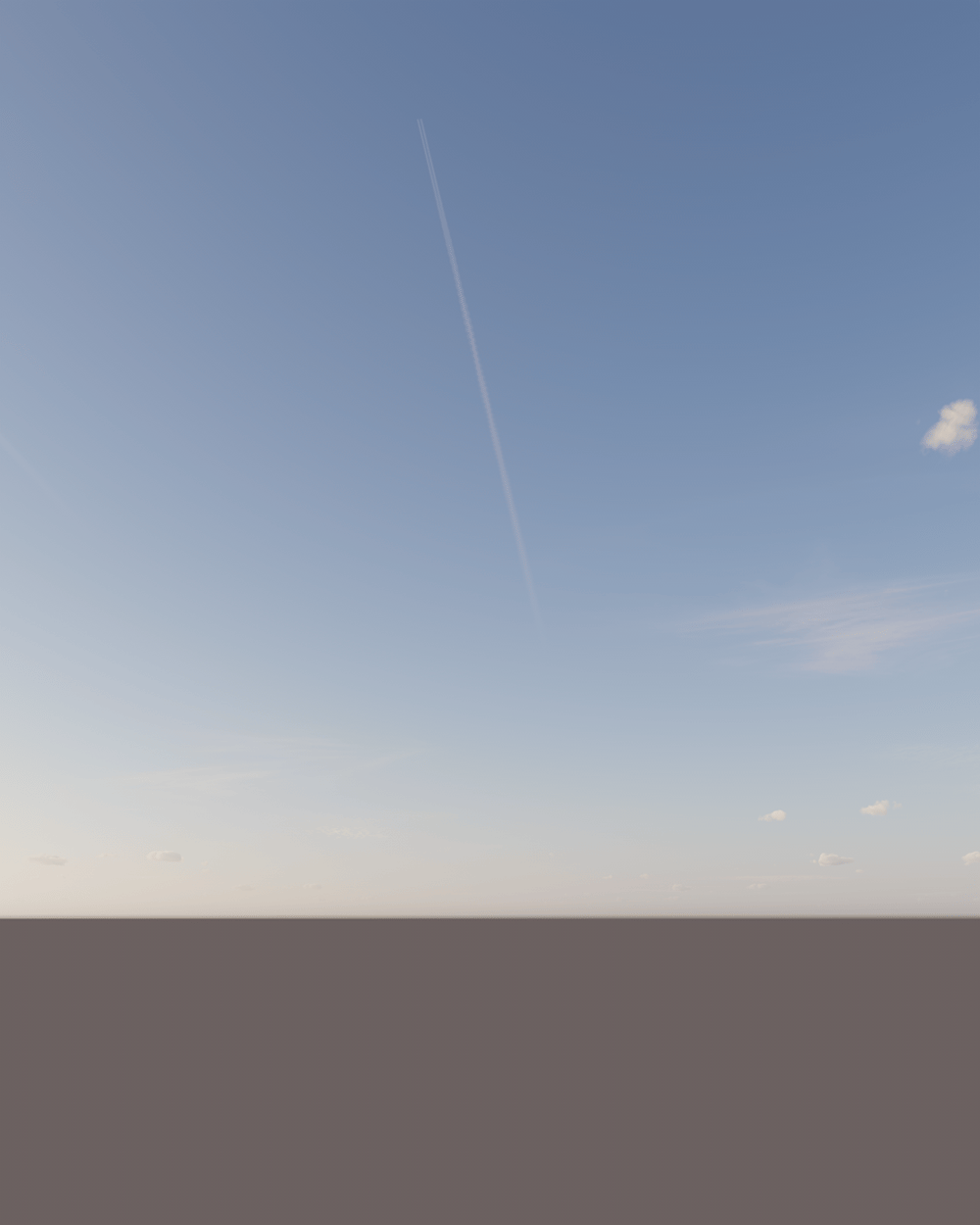
Time = 1
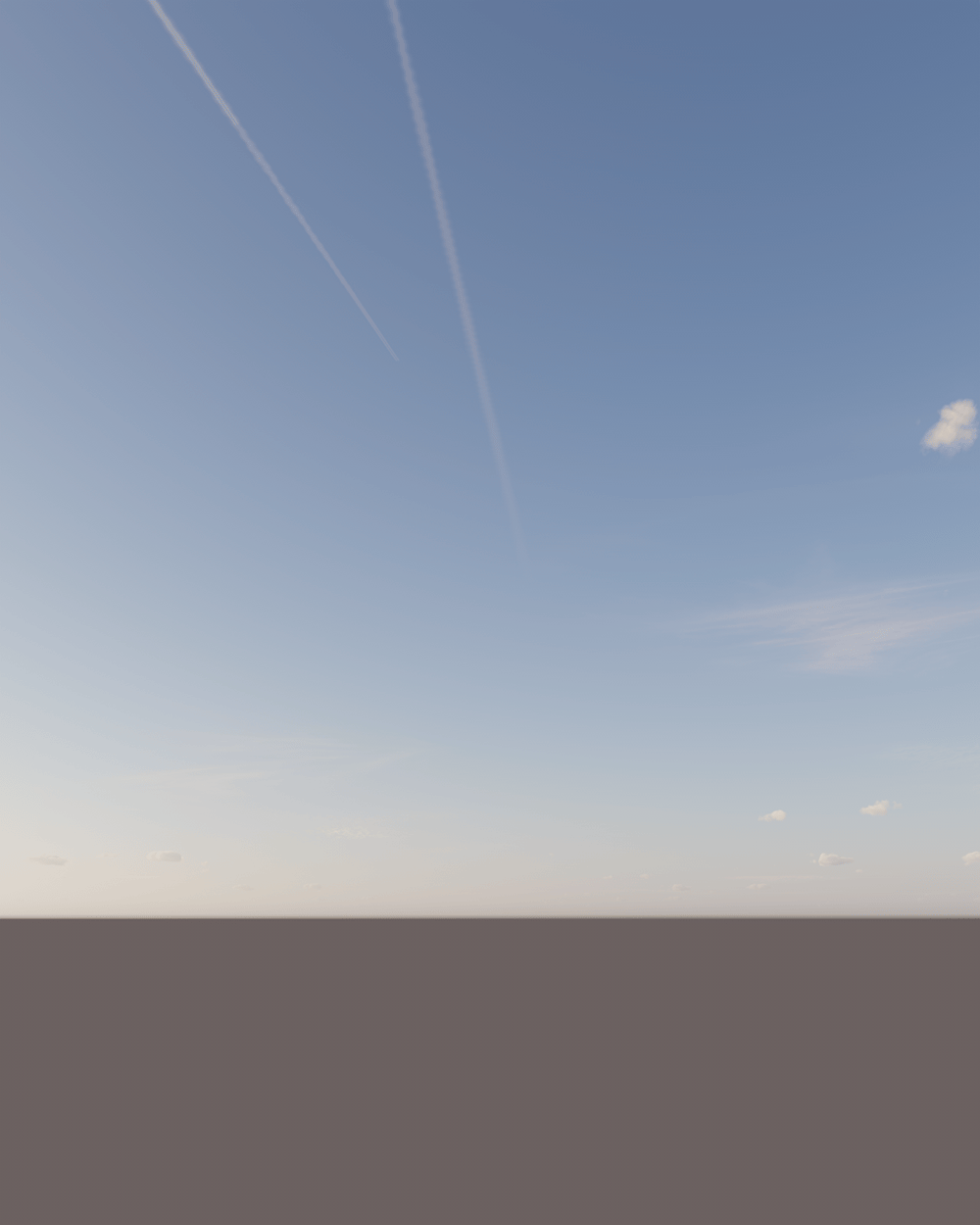
Time = 2

Time = 3

Time = 4
Clouds Contrails - Strength

Strength = 0%

Strength = 25%

Strength = 50%

Strength = 100%
Clouds Contrails - Distortion

Distortion = 0%

Distortion = 25%
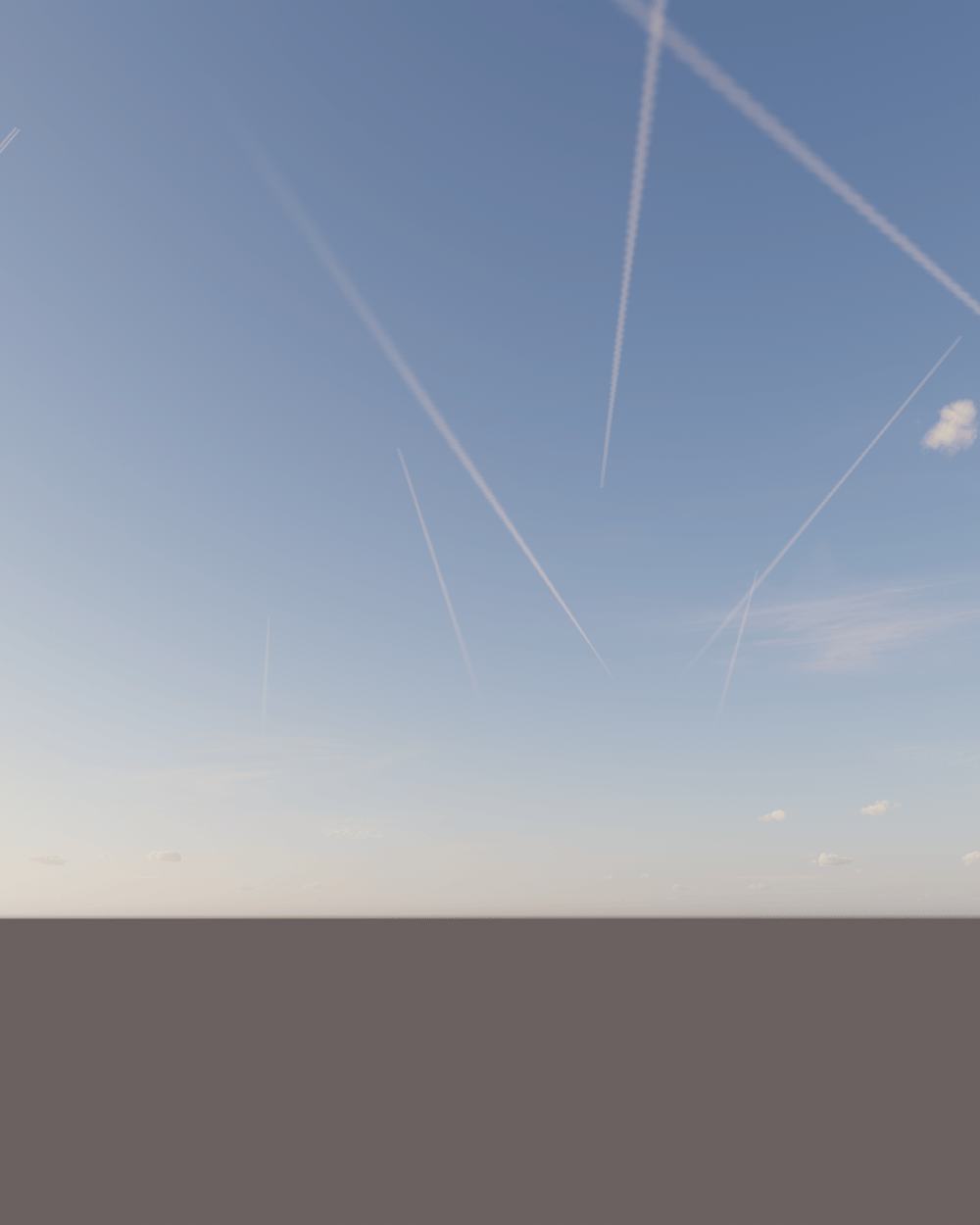
Distortion = 50%

Distortion = 100%
Sun Direct input - Color

Green

Black

Red

Yellow
Sun Positioning - Various

Position 1

Position 2

Position 3

Position 4
Stars
Enable – Enable to render stars in the sky.
Size mult. – Size multiplier for the stars.
Size diff. – Determines how much faint stars will differ from bright stars in size.
Intensity mult. – A multiplier for the stars' intensity.
Milky Way mult. – A multiplier for the Milky Way galaxy intensity.

Stars Examples

Stars are disabled

Stars are enabled
Size Mult.
Size mult. = 100% (default)

Size mult. = 200%
Size Diff.
Size diff = 0% (default)

Size diff = 100%
Intensity Mult.
Intensity mult. = 100% (default)

Intensity mult. = 200%
Milky Way Mult.

Milky Way mult. = 100% (default)
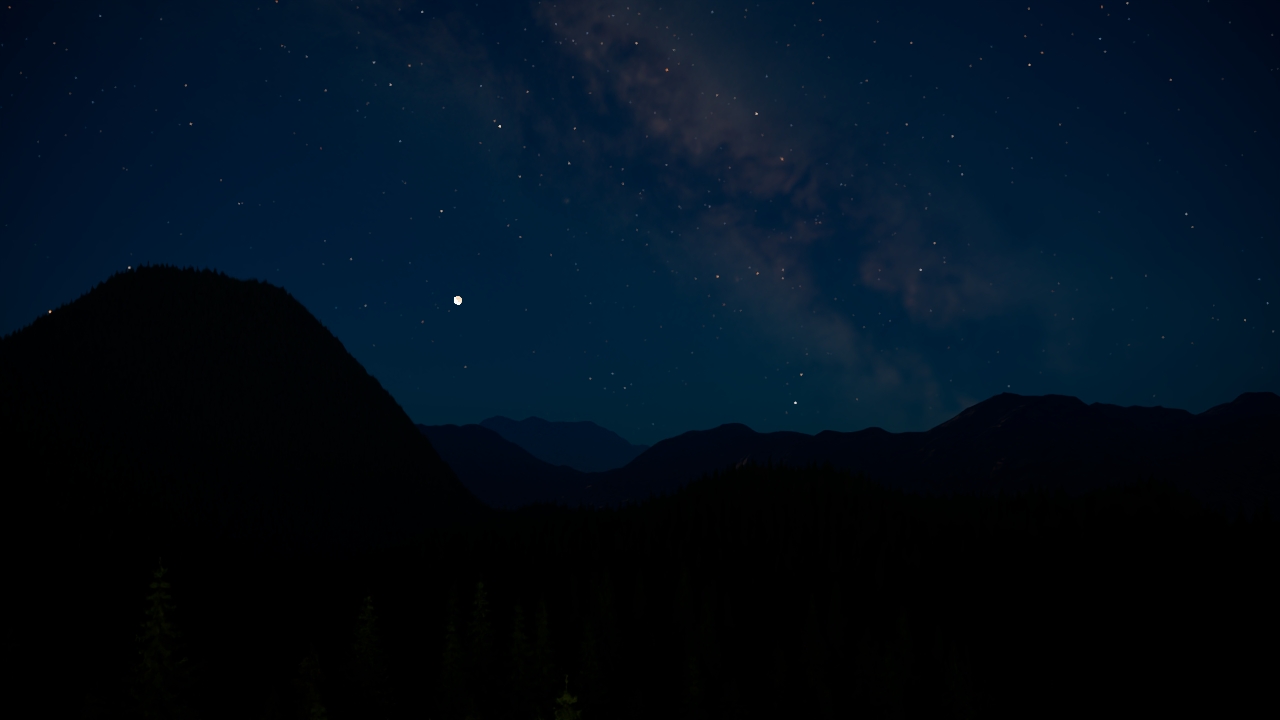
Milky Way mult. = 200%