Use the V-Ray Noise A texture to create procedural noise with two colours or texture maps.
Overview
The Noise A texture generates procedural noise using two colours. You can assign a texture map to either colour.


UI paths
||V-Ray Asset Editor|| > Textures (right-click) > Noise A
||V-Ray Asset Editor|| > Create Asset (left-click) > Textures > Noise A
Parameters
Color A controls the first colour used by the Noise procedural. A selected texture overrides the colour while the texture checkbox is enabled.
Color B controls the second colour used by the Noise procedural. A selected texture overrides the colour while the texture checkbox is enabled.
Type sets the type of noise the Noise procedural creates.
Noise
Perlin
Inflected Perlin
Marble(with Perlin)
Amplitude controls the range of the Noise.
Frequency controls the amount of Noise generated. Higher values create smaller, finer noise.
Inflection turns the inflection effect on or off.
Color Manipulation
Invert Texture inverts the texture's RGB values.
Alpha from Intensity uses the texture's RGB intensity or luminance as the alpha channel.
Color Gain adjusts the texture colour by multiplying its RGB values by the RGB values you specify here. A selected texture overrides the colour while the texture checkbox is enabled.
Color Offset adjusts the texture colour by adding the RGB values you specify here to the texture's RGB values. A selected texture overrides the colour while the texture checkbox is enabled.
Default Color sets the colour for polygons without valid UVs. If the map is not tiled, it also sets the colour outside the texture square. A selected texture overrides the colour while the texture checkbox is enabled.

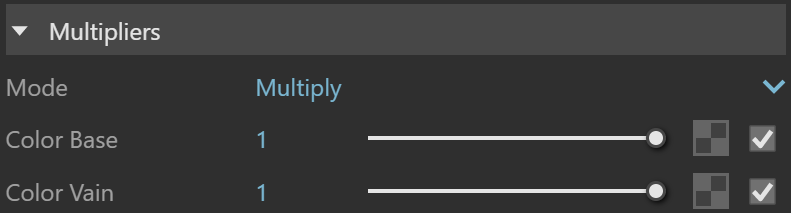
Multipliers
Mode sets the multiplication mode for the colours.
Multiplier multiplies each top-layer pixel's RGB values by the corresponding bottom-layer pixel's RGB values. This produces a darker image. The blending colour is black.
Blend Amount uses each pixel from the top layer if present. Otherwise, it uses the bottom layer. The blending colour is the colour specified in the colour slot.
Color A blends between a colour and a texture, if you specify one.
Color B blends between a colour and a texture, if you specify one.
Texture Placement
Type controls how the texture is positioned on the geometry.
2D (UV Channel) uses the object's UV coordinates.
3D (Object Space) positions the texture using local object coordinates, independently of the object's UVs.
3D (World Space) positions the texture using world coordinates, independently of the object's UVs.
Environment applies when the map is connected to an Environment slot or a Dome light.
Texture Remapping uses UVW values from a colour texture or separate greyscale textures.
Mapping Source uses an external UV placement source.
2D (UV Channel)
UV Channel/Set sets the index of the mapping channel data to use. A value of 1 uses the first available channel.
Repeat U/V sets how many times the texture repeats within the 0 to 1 UV square.
Lock U/V Repeat locks the U/V Repeat.
Offset U/V controls the texture offset in the U and V directions.
Rotate rotates the texture in degrees.
Tile U/V tiles the texture in the U and V directions. When disabled, the Default texture colour appears outside the 0 to 1 UV square. Find the default colour under Parameters > Color Manipulation.
Mirror U/V mirrors the texture separately in the U and V directions. It splits the texture in half and flips one side vertically or horizontally. Use it to avoid seams between repeated textures that do not tile.

2D (UV Channel) parameters
3D (Object Space)
Repeat X/Y/Z sets how many times the texture repeats along the X/Y/Z axes.
Lock U/V Repeat locks the X/Y/Z repeat.
Offset X/Y/Z controls the texture offset in the X/Y/Z directions.
Rotate X/Y/Z rotates the texture around the X/Y/Z axes.
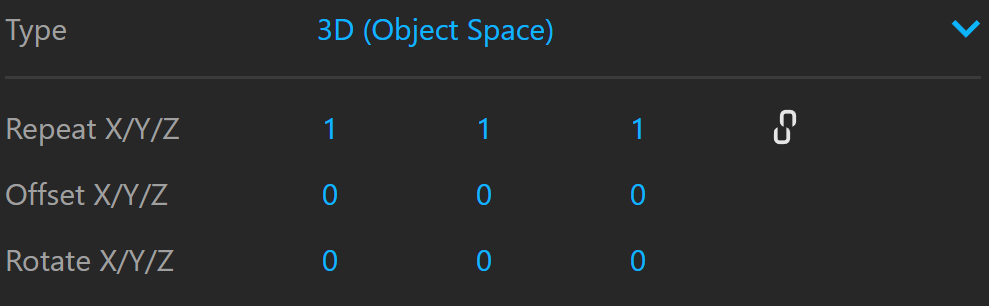
3D (Object Space) parameters
3D (World Space)
Repeat X/Y/Z sets how many times the texture repeats along the X/Y/Z axes.
Lock U/V Repeat locks the X/Y/Z repeat.
Offset X/Y/Z controls the texture offset in the X/Y/Z directions.
Rotate X/Y/Z rotates the texture around the X/Y/Z axes.

3D (World Space) parameters
Environment
Mapping sets the texture's type and shape.
Angular
Cubic
Spherical
Spherical Inverted
Mirror Ball
Screen
Rotate H rotates the environment sphere horizontally.
Flip H flips the environment sphere horizontally.
Rotate V rotates the environment sphere vertically.
Flip V flips the environment sphere vertically. It is active only in Spherical Mapping.
Ground enables ground projection of the texture.
Position X/Y/Z offsets the ground projection along the X/Y/Z axes.
Radius sets the projection radius. Use it to control the projection's scale.
For 2d Transformation, see the 2D (UV channel) parameters.
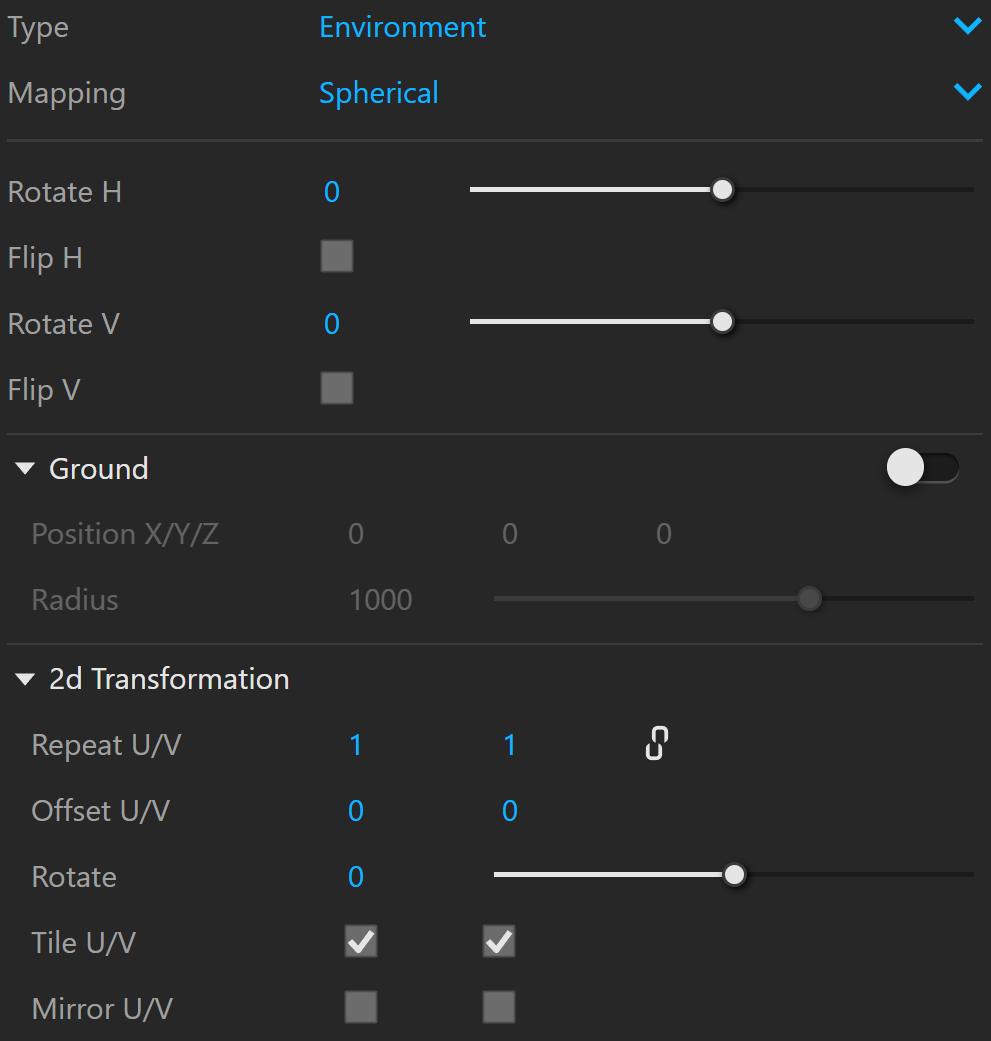
Environment parameters
Texture Remapping
Mode sets whether to use a single texture or multiple textures to remap the U and V texture coordinates.
UV uses the input texture's Red channel to set the U sampling coordinate. Its Green channel sets the V coordinate.
U uses this texture's value to set the U sampling coordinate.
V uses this texture's value to set the V sampling coordinate.

Texture Remapping parameters
Mapping Source
UV Placement Source sets the external UV placement source for the texture.

Mapping placement parameters