
Use the Translucent material type in KeyShot to control subsurface scattering in skin, plastic and other materials. |
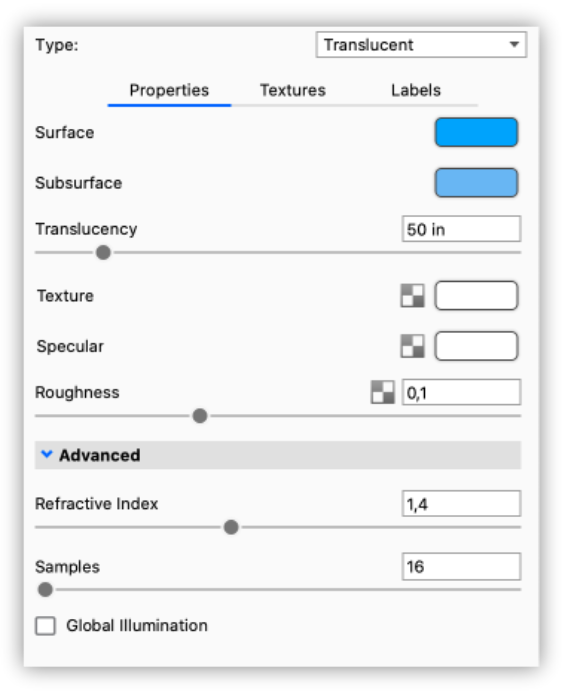
Surface Color This sets the diffuse colour of the material's outer surface and its overall colour. If the surface colour is completely black, you will not see the translucent effect of the subsurface colour. Subsurface Color This sets the colour light takes on as it passes through the material. Skin is one example. Bright light passing through the thin parts of an ear or the thin skin between fingers appears redder because of what lies beneath the surface. As light passes through the surface, it scatters in random directions. This creates a soft translucent effect rather than the direct refraction seen in glass and similar materials. For plastic materials, you will often use a colour close to the surface colour, but slightly brighter. |
Translucency
This controls how deeply light passes into and through the surface, using the units set under Edit > Set Scene Units. Higher translucency values show more subsurface colour through the surface and make the material look softer.
Texture
This affects the Surface Color setting by multiplying and blending the surface colour. For example, a yellow Surface Color and a blue Texture Color produce green. A white texture colour leaves the surface colour unchanged.
Specular
This controls the intensity of surface reflections. It works with the Refractive Index setting to increase or decrease their strength.
Roughness
Increasing roughness spreads reflections across the surface and makes it look more matte.
Advanced
Refractive index
This controls how much light bends, or refracts, as it hits and passes through parts with this material. Start with the default value of 1.4. Increase it for stronger refraction within the surface.
Samples
A low samples setting (8 or lower) tends to make the surface look noisier, rougher and less uniform. Increasing the value reduces noise and distributes the roughness more evenly.
Global illumination
This enables Global Illumination for the material independently of the general Lighting setting for Global Illumination.